



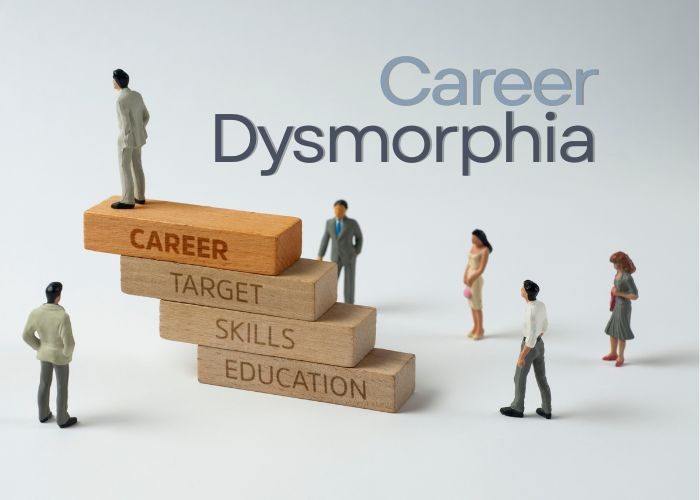
Amit, 32, earns Rs 55 lakhs annually in a role most would consider enviable. He’s promoted faster than peers, oversees significant responsibilities, and holds the trajectory of someone destined for senior leadership. Yet he confesses to feeling like a failure. His manager, a Gen X leader, struggles to comprehend the disconnect: objectively, Amit is succeeding by every measurable standard. Emotionally, he experiences himself as falling behind.
This quiet tension—where achievements feel insufficient and success appears small through one’s own lens—reveals something HR leaders increasingly confront: career dysmorphia. Like body dysmorphia, where individuals perceive flaws invisible to others, career dysmorphia distorts professionals’ perception of their own achievements. It’s an emotional glass ceiling where personal reflection never quite matches the imagined ideal.

The phenomenon spans generations but manifests differently across age cohorts. Gen Z battles impatience, believing career progression should accelerate beyond realistic timeframes. Millennials wrestle with mid-career anxiety despite objective success, feeling perpetually “late” in their trajectories. Gen X confronts relevance questions in a rapidly evolving digital landscape. Yet beneath these generational variations lies a common thread: the erosion of satisfaction in professional effort itself.
From effort to exhibition
Pankaj Lochan, CHRO, Navin Fluorine, articulates how career perception has fundamentally shifted within his own generation. “I never knew this was called career dysmorphia, but I see it all around me every day,” he reflects.
As a Gen X leader, Lochan describes how his generation measured progress differently. “We were more focused on the cause rather than the effect—the effort rather than the outcome. We didn’t constantly feel behind.” Success was private, incremental, and deeply personal. Professionals compared themselves to their previous selves, not the world.
“It’s like walking into a carnival of distorted mirrors. You look fine, but every reflection looks stretched or shrunken. That’s how LinkedIn has made careers appear—distorted.”
Pankaj Lochan, CHRO, Navin Fluorine

This inward-looking approach has yielded to relentless visibility. “Now,” Lochan observes, “every LinkedIn post feels like a report card.” The shift from satisfaction in effort to obsession with results represents a fundamental generational pivot. Gen X grew up without digital scoreboards; report cards arrived twice yearly and recognition remained personal rather than public. Self-worth wasn’t tethered to social comparison.
Today’s professionals operate under constant observation, measuring progress against curated success stories online. “It’s like walking into a carnival of distorted mirrors,” Lochan suggests. “You look fine, but every reflection looks stretched or shrunken. That’s how LinkedIn has made careers appear—distorted.”
The psychological cost extends beyond individual anxiety. “LinkedIn has created illusions of professional inadequacy,” he argues. The result is an ecosystem where gratitude and groundedness—once central to professional identity—have eroded. Success no longer feels sufficient unless it’s visible, shared, and publicly applauded.
The millennial paradox
Between Gen X’s constrained ambition and Gen Z’s impatience sits Millennials—a generation coming of age during technological booms, economic recessions, and the rise of social media validation.
“They are the ones who feel they should have done better, even when they’re objectively doing great,” Lochan observes of his Millennial colleagues. A 32-year-old earning Rs 55 lakhs believes themselves “late” in life, though late to what precisely remains unclear.
Millennials present a defining paradox: the most educated, fastest-promoted generation in corporate history is also the most anxious. The roots run deep. They witnessed Gen X’s stability but inherited a world where job security had evaporated. They watched peers leapfrog through startups and unicorns whilst simultaneously confronting an expanded definition of success itself. More opportunities created more internal pressure to capitalise on them.
This endless benchmarking fuels millennial dysmorphia. The generation often conflates lack of purpose with lack of progress, interpreting disconnected work as personal failure. “They’re not just chasing promotions,” Lochan explains. “They’re chasing purpose, visibility, validation—all simultaneously.”
That relentless pursuit traps many in compulsive upskilling without direction—accumulating certifications and making lateral moves not from genuine skill gaps but from anxiety-driven obligation. “Continuous learning is essential—but only when it is purpose-driven,” notes Lochan. “When learning becomes a compulsive response to insecurity, it stops being developmental and becomes destructive.”
For many Millennials, the glass ceiling isn’t external—it’s entirely self-imposed.
The acceleration trap
If Millennials feel late, Gen Z feels rushed. Rishav Dev, head – talent acquisition, Century Plywoods, identifies the core challenge: “They believe they should be rewarded for every initiative they take. They want promotion within six months because they feel they’ve done enough.”
“Gen Z has immense talent, but their self-acceptance is low. They want to grow fast, but they’re unable to acknowledge how far they’ve already come.”
Rishav Dev, head – talent acquisition, Century Plywoods

This isn’t arrogance but conditioning. “They’ve grown up in an environment of instant gratification. Everything from feedback to success has been on-demand.” Such expectations abbreviate patience whilst inflating achievement thresholds. When rapid results don’t materialise, frustration builds and eventually internalises as self-doubt.
Critically, Gen Z rarely voices these anxieties at work. “They’re not comfortable sharing these concerns,” Dev observes, “so the stress builds quietly.” The result manifests as attrition—people departing within months, sometimes weeks, having never articulated their struggles to management.
Behind job-hopping lies low self-acceptance. “Gen Z has immense talent,” Dev acknowledges, “but their self-acceptance is low. They want to grow fast, but they’re unable to acknowledge how far they’ve already come.”
This gap carries organisational costs beyond individual burnout: constant hiring, training, and turnover strains productivity and culture. Dev’s counsel cuts through complexity: “Learn to accept yourself. Don’t live anybody else’s life. If you don’t accept yourself, you can’t expect the world to accept you.”
Reorienting perspective
Career dysmorphia represents not professional failure but emotional misalignment—a mismatch between expectation and reality, effort and recognition, pace and purpose. Breaking through requires redirecting focus from comparison to contribution.
Dev emphasises the HR imperative: “Organisations must now focus on psychological safety in careers. That means helping employees view growth as a spectrum, not a sprint.” He advocates normalising what he calls “career stillness”—the idea that pausing without panic constitutes healthy reflection rather than failure.
“We’ve glorified acceleration so much that standing still feels like failure,” Dev reflects. “But reflection is also growth.” This challenges the relentless productivity narrative that defines contemporary work culture, suggesting that periods without visible advancement may offer more genuine development than constant motion.
Lochan emphasises the historical perspective: “Our generation built careers brick by brick. Today, people want skyscrapers without foundations.” He reminds professionals that “gratitude, patience and self-awareness are not outdated virtues; they’re survival skills”—particularly in an era where comparison has become instantaneous and omnipresent.
The path through
Breaking through career dysmorphia requires professionals to shift their internal gaze—from benchmarking against others’ curated achievements to assessing their own contribution and growth. The invisible glass ceiling cracks not through promotions, pay raises, or social media applause, but when professionals rediscover satisfaction in effort itself rather than its public reflection.
As Dev aptly articulates: “You can’t live somebody else’s life. The mirror will never reflect peace if you’re always looking at someone else’s reflection.”
Career success doesn’t require visibility to be genuine. It requires only to be felt—a shift in orientation that may prove the most consequential career development professionals encounter, regardless of their generation.
5 Comments
a very timely and well written article . infact I am already seeing the long term impact of unchecked career dysmorphia leading to self imposed isolation , aggression and self harm . clearly there are interventions required to stem the spread . For successive generations , a conscious and compelling intervention perhaps starting at the college level on self identity and work could help
“Dil maange more” is evident at every workplace but somewhere this trend is reducing/narrowing the perspective of life to only career achievements. Many a times relationships both at work and at home are compromised for one pie of life.
Additionally I believe this gets further amplified in India where the focus is more often on academics from early childhood and rarely and passions developed .. life is limited to just a reflection of how one fares at work !
One of the best articles.
One of the best articles.
Got to know trends and related concepts expressed and well explained.