


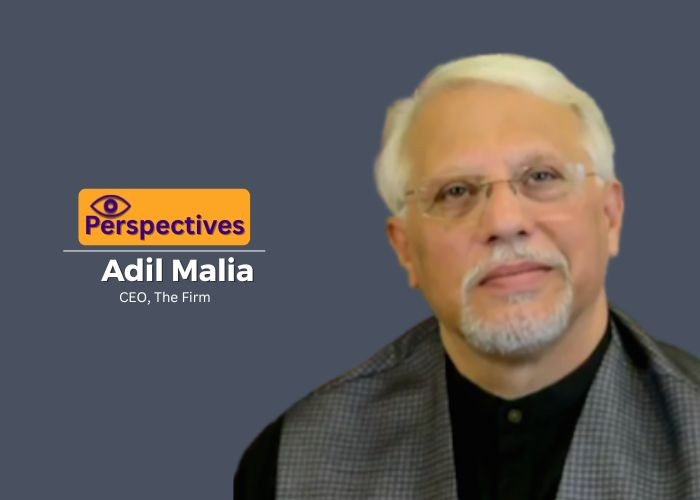
Four decades in human resources provides perspective that quarterly earnings calls and annual strategy reviews cannot. Adil Malia has witnessed the transition from personnel management to strategic HR, from manual processes to AI-driven analytics, from stable career ladders to fluid talent markets. His career spans the Godrej Group, GE Appliances, Coca-Cola and the Essar Group—contexts where people strategies must adapt to vastly different operational realities, from consumer goods to heavy industry.
Now CEO of The Firm, Malia articulates a philosophy shaped by longevity: technical skills depreciate rapidly, but the ability to empathise, connect and lead through technological disruption remains constant. In conversation, he explains why organisational neuroplasticity matters more than domain expertise, why AI should be framed as augmented rather than artificial intelligence, and why his own pivot from HR to sales taught him more about effective people programmes than any HR assignment could.
Neuroplasticity over technical mastery
Technical skills depreciate rapidly. How should organisations hire and develop for adaptability rather than static expertise?
In a universe where technology changes at blistering speed, it is only natural that the knowledge, technical skills and competencies required to drive these technologies are short-lived. By the time one invests in mastering a new skill, it’s already time to write its obituary and sing a birthday song to the next emerging technology that’s hot in market demand.
The good news for this bad copy is that soft skills—the ability to empathise, connect and lead people through shifting technologies—are becoming increasingly critical.
Success in such a high-speed, techno-centric world inevitably comes with frustrations, failures, pressures, fatigue, mindlessness, indiscretions, depression and even breakdown in family values. Achieving consistent productivity in such a setting is not easy. That’s why agility, learnability, adaptability, anti-fragility, neuroplasticity and influenceability are emerging as the most crucial leadership competencies.
Future-ready organisations demonstrate a very high level of neuroplasticity—the capacity of the organisational “brain” to change and adapt in response to disruption or injury. When technology shifts gears so rapidly, human errors and setbacks are inevitable. The ability of leaders to soften the impact through empathy and resilience drives the organisation’s future readiness.
Hence, hiring leaders for soft skills and adaptability rather than just technical expertise or domain knowledge is truly the way forward.
“AI isn’t artificial; it’s augmented. It doesn’t replace human intelligence — it amplifies it.”
Context determines build versus buy
How do you view the trade-off between developing leaders internally versus hiring externally?
This is a classic debate that rarely finds a clear solution. If you argue for “building”, someone will make a strong case for “outsourcing”, and vice versa. The answer depends entirely on context.
If your business value chain is unstable and the technological environment is high-octane, I would suggest outsourcing talent, supported by sharp short-term incentive plans and medium-term retention programmes. However, if your business value chain is stable and technological change happens gradually and predictably, then building your own talent for the long term—backed by stable retention initiatives and long-term wealth creation schemes—is the better route.
There are no cookie-cutter answers here. You must diagnose the system’s criticality first and then design your strategy and interventions accordingly.
“Technical skills depreciate faster than smartphones; adaptability doesn’t.”
Augmented, not artificial
How can leaders help employees view AI as an enabler rather than a replacement?
AI should not be seen as Artificial Intelligence but as Augmented Intelligence. Technology provides us with tools and applications that enhance human intelligence—helping us think sharper, act faster and generate insights that meet the needs of consumers, customers, vendors, employees and all other stakeholders more effectively.
Employees must be initiated, indoctrinated and inducted into the use of AI as a partner that enhances their efficiency—not as a tool that will substitute or replace them.
Successful organisations create a sense of excitement and discovery around the high potential of AI tools to boost performance. They don’t build a morbid, graveyard-silent organisation of pallbearers who welcome new technology in the hearse van of displaced employment.
“Hire for neuroplasticity — the mind’s ability to adapt — not just for technical mastery.”
The unconventional path
What was the most important decision or experience that shaped you as a people leader?
Whilst soft skills can be developed when needed, I was perhaps blessed with a natural abundance of them. They first showed up in my family, gradually in school and college, and eventually at the workplace as I faced professional challenges.
These skills were further refined under my mentor, Bob Amar of GE in the US, who hand-held me through the process of creating enterprise value through empathy, engagement and people connection. My parents and my maternal aunt, who personally nurtured me, also played a pivotal role in shaping my people orientation.
Equally important, though often underappreciated, is the role of a mature and people-centric spouse—someone who, during your workplace dilemmas (which you sometimes carry home), can coach and subtly guide you towards a positive perspective. Home mentoring for workplace efficiency plays an unspoken but immensely powerful role in shaping leadership behaviour. I was more than fortunate on that front.
To my 25-year-old self, I would say: you need to be blessed, you need to be on edge, and you need a supportive partner to become an empathetic leader in this neuroplastic world.
“Leadership isn’t about choosing empathy over efficiency; it’s about knowing when to lean on each.”
The pivot that taught everything
How do you build a career that gives you breadth across HR functions whilst developing deep expertise?
Career pivots are critical to success—you need to see your world from another window. Have you ever looked at your home from the house across the street? You’d be surprised by how different it appears. That’s what stepping into another role feels like.
My own HR career pivot happened when I moved from HR to marketing and frontline sales at M&S. That experience was truly transformative. I realised that none of the HR programmes I had designed connected effectively with the sales teams I was leading. When I complained, the new HR manager (who had taken over my earlier role) simply told me he hadn’t changed a thing. That’s when I realised—the programmes never connected in the first place.
That stint taught me more about business, people and customer orientation than any HR assignment could. My advice: don’t wait for such opportunities to fall into your lap. Don’t rely on serendipity—go out and seek those cross-functional experiences actively. They will shape you into a truly well-rounded HR leader.
“A mentor shapes your skills. A supportive partner shapes your perspective.”
The essential trade-off
What’s the trade-off that stayed with you the most, and how did you navigate it?
The trade-off that has stayed with me the most is empathy versus efficiency.
People drive efficiency, so people should prevail. But without efficiency, businesses cannot thrive—and when businesses don’t thrive, people can’t succeed either. Both are essential.
A good leader knows when to lean on empathy and when to push for efficiency. Leadership isn’t about choosing one over the other—it’s about knowing when and how far to go with each.