


Edelweiss Life Insurance operates in a sector where competitive advantage is shifting. Products can be replicated. Distribution can be matched. What is harder to copy is the capability of the people building, selling and transforming those products as insurance becomes more data-led, technology-enabled and heavily regulated.
That makes the talent equation more complicated. Traditional insurance expertise remains indispensable, but it now has to sit alongside AI, cybersecurity, data privacy and customer-experience capabilities that barely featured in the industry’s talent plans a decade ago. The question for HR is no longer simply whether the organisation has enough people. It is whether it has enough of the capabilities the business will need next.
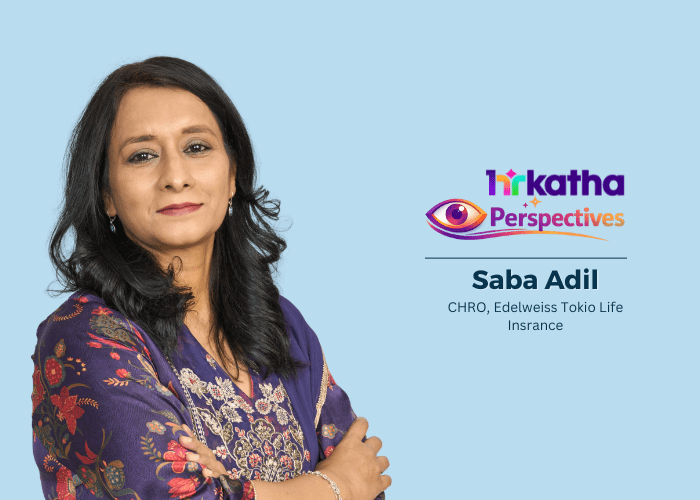
Saba Adil starts people decisions with a demanding test: what changed in the business because HR did something? In conversation with HRKatha, she explains why developing 70 per cent of talent internally is a deliberate philosophy rather than a cost-saving measure, why people data becomes useful only when different signals are read together, and why developing valuable talent creates its own retention problem.
Three buckets, one talent strategy
As insurance changes, which capabilities must be built internally and where do you still need to buy expertise from the market?
We think about talent across three distinct buckets.
The first is core insurance capability: actuarial, underwriting and the other foundational functions on which the industry is built. These remain critical and non-negotiable.
The second is shared services with an industry lens: finance, administration, HR and operations. These functions cannot simply be applied generically. They need to operate within the regulatory and risk environment specific to insurance.
The third is emerging skills. Data and technology have been evolving for some time, but rapid advances in AI and machine learning have changed the nature of those requirements significantly. We are also seeing growing demand for customer-experience roles, cybersecurity, data privacy and capabilities related to regulatory developments such as the Digital Personal Data Protection framework and IFRS implementation.
Across these buckets, our larger philosophy is to grow our own timber. Wherever possible, we develop people from within through structured programmes, coaching, mentoring and exposure to capabilities such as design thinking.
There are, however, moments when transformation requires expertise that does not yet exist internally. That is when we bring in external talent, whether in technology, data privacy, IFRS or other emerging areas.
Around 70 per cent of our talent comes from within the organisation, giving us continuity as people move into higher responsibilities across technical, functional and leadership roles. The larger task is continuous talent-gap analysis: where are we today, where do we need to go, what capabilities are missing, and where do we need to invest?
That is how we prepare the organisation for what comes next.
“The paradox is unavoidable: the better you become at developing talent, the harder you may have to work to keep it.”
What the data actually tells you
People analytics gives HR more data than ever. How do you know when it is actually improving a talent decision rather than simply measuring it more precisely?
We have access to a significant amount of data: productivity, talent retention, offer-to-joining ratios and a range of lead and lag indicators. But the important thing is to combine variables to understand the larger story. One data point rarely tells you enough.
Take engagement. Our engagement scores improved last year, but that number matters only when we ask whether the improvement correlates with lower attrition and higher productivity. If engagement is rising while those metrics are not moving, the score is telling you something incomplete.
The same principle applies to hiring. We look at the strength of the entire funnel, including offer-to-joining ratios and turnaround times, to identify bottlenecks and understand where intervention is required.
Succession planning is another area where data matters. We track our leadership depth index and assess how many people are ready now, ready later or available as emergency successors for critical roles. We also use 180-degree feedback to understand how middle leaders are perceived on competence, value addition and trust, and compare that with their own assessment.
Our intent is that every HR initiative should ultimately move a business metric. If we introduce a leadership intervention, for instance, we want to know whether it improves our leadership index. We establish where we were before the intervention and assess again afterwards to see whether the needle has moved.
The value of people analytics is not in having more numbers. It is in bringing different numbers together until they tell you something useful.
“Women account for 39 per cent of our frontline sales workforce. Those cohorts show higher productivity and lower attrition than the broader workforce.”
Learning that escapes the classroom
Employees are more willing to learn than they were a decade ago. How do you turn that curiosity into capability that actually shows up at work?
One positive change I have seen is that people are increasingly curious about the changing world of work. After so much change over the past eight to nine years, employees recognise that they need to keep learning.
You can see this particularly with AI. There is genuine excitement, and people actively want to understand what it means for their work. Many take courses independently to build knowledge of data or strengthen their technical capabilities. That is a significant shift from a decade ago, when HR often had to drive participation in learning programmes.
We sustain that curiosity through initiatives such as Lunch and Learn and brown-bag sessions, where employees can use an hour of the workday to learn about AI, data or another relevant subject. Many are voluntary, and voluntary learning creates a greater sense of ownership than mandated participation.
The harder problem is maintaining momentum. Someone may attend a Level 1 workshop, but how do you take that person to Level 2 and Level 3 while they are also doing a full-time job?
Learning therefore cannot stop at the workshop. It has to move into live projects. If employees attend an AI workshop and want to experiment with new tools, the organisation needs to create room for that experimentation. Experiments can become projects. Quick wins can be celebrated and outcomes shared. Even when something fails, there is something to learn from it.
That is how learning becomes part of work rather than an activity alongside it: keep seeding relevant programmes, invest in capability and give people somewhere real to apply what they have learnt.
“The manager-as-coach approach is not simply a leadership philosophy. It is a retention mechanism with measurable outcomes.”
Managers who coach, not just deliver
In a business with large, dispersed frontline teams, how do you avoid promoting people who can deliver numbers but cannot lead people?
At branch level, the manager can effectively become the organisation for an employee. Their interactions shape how that employee experiences the workplace every day.
That is why we focus on people leadership from the point of hiring. Our assessment tools look beyond aptitude and functional capability to behavioural and leadership dimensions. As people move into more senior roles, the assessment becomes more sophisticated, but the principle remains the same: technical, behavioural and leadership capabilities have to be assessed together.
Development then needs to continue throughout the employee journey. We give managers practical, bite-sized interventions on how to lead more effectively. Sometimes these are straightforward things: recognising an employee, understanding what motivates someone or creating a moment of connection with the team. They may appear small, but together they create a more personalised employee experience.
We have also seen tangible results from mentor-mentee initiatives. Cohorts where mentors have been paired with mentees have shown lower attrition and improved performance. The manager-as-coach approach is therefore not simply a leadership philosophy. It is a retention mechanism with measurable outcomes.
But getting the right people into management roles in the first place matters just as much as developing them once they are there. Once you have the right managers, you can develop them and align their behaviour with the organisation’s culture. If the selection itself is wrong, development can only compensate so far.
“Getting the right people into management roles in the first place matters just as much as developing them once they are there.”
Diversity where it changes the business
You have 39 per cent women in frontline sales. What does that experience tell you about when diversity begins to affect business outcomes rather than just representation?
We started with frontline sales because salespeople interact directly with customers. We wanted our workforce to reflect the diversity of the customer population we serve.
Today, women account for 39 per cent of our frontline sales workforce. That is meaningful representation in a function where women’s participation has traditionally been lower. We built this deliberately through strong people practices and mature people leadership. The outcomes support the approach: those cohorts show higher productivity and lower attrition than the broader workforce.
Overall, women’s representation across the organisation is around 34.5 per cent. The next focus is increasing representation in senior leadership, and that is something we are actively working towards.
Our approach combines meritocratic, performance-oriented hiring with an inclusive culture where different perspectives, backgrounds and experiences are genuinely welcomed. Managerial maturity matters here because leaders need to create environments in which everyone can contribute and perform at their best.
We also provide practical support through flexible working arrangements, including during maternity, as well as employee resource groups and women’s circles. The objective is not simply to get people into the organisation. It is to create the conditions in which they can stay and grow.
“Engagement scores mean little unless they move alongside attrition and productivity.”
The capability paradox
If you had to prove HR’s contribution to the CEO and Board through three measures, what would you choose? And what is the trade-off those metrics do not capture?
The metrics I care most about are those that connect culture and people outcomes to business performance.
Business delivery comes first: top-line and bottom-line performance, cost ratios and customer metrics such as NPS. These matter because they tell us whether the internal culture we are building ultimately serves the customer.
The connection I track particularly closely is between people NPS and customer NPS. If we want customer NPS to improve, people NPS needs to move first. Employee experience, culture and business outcomes are not separate conversations. They are different stages of the same journey.
The third measure is capability readiness: whether the organisation is building the skills it will need two or three years from now rather than simply filling today’s roles. Leadership depth, learning penetration and the strength of the internal pipeline all feed into that picture.
The hardest trade-off connects directly to capability readiness. You invest in people, develop them and make them future-ready. Then the market notices.
Demand for high-capability talent is intense in financial services, and the people you have developed become attractive externally at exactly the point when they are most valuable internally.
That is a good problem to have because it means you have built something real. But it creates another question: how do you keep people interested, give them a sense of belonging, support their career aspirations and create enough opportunity for them to grow inside rather than outside the organisation?
Career pathways, continuous capability development and culture all matter. There is no single retention lever. The paradox is unavoidable: the better you become at developing talent, the harder you may have to work to keep it.
“Around 70 per cent of our talent comes from within, providing continuity as people move into higher responsibilities.”