


Industrial technology companies occupy a peculiar position. They operate at the intersection of digital, physical and industrial systems—where software meets hardware, where innovation must coexist with reliability, and where cutting-edge solutions require deep domain expertise accumulated over decades. This creates competing imperatives: embrace technological disruption whilst preserving institutional knowledge, build agile capabilities whilst maintaining operational excellence, and attract digitally native talent whilst valuing experienced professionals.
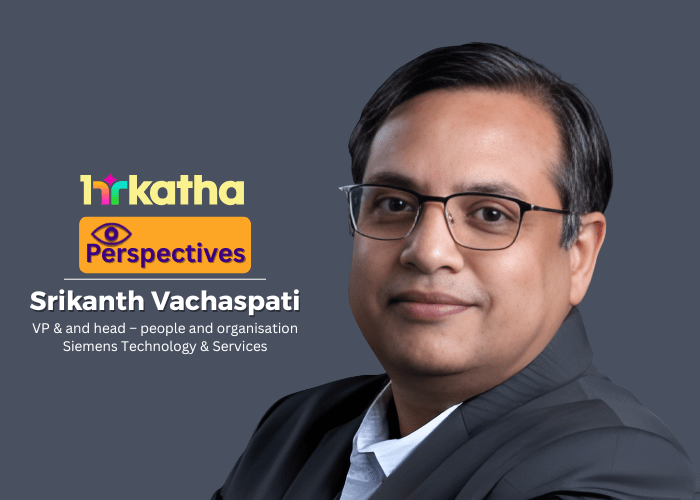
Srikanth Vachaspati, vice president and head – people and organisation at Siemens Technology and Services, navigates these tensions daily. In conversation, he articulates why curiosity and adaptability matter more than specific technical skills, why resistance to AI stems primarily from fear of irrelevance, and why the most persistent challenge involves balancing rapid technological change with generational diversity in ways that allow both digitally native and deeply experienced professionals to contribute meaningfully.
Mindset over credentials
Are you hiring for skills that exist today or for curiosity and adaptability to learn what doesn’t exist yet? How do you define future-ready talent at Siemens?
At Siemens Technology and Services, we believe technical skills may open doors, but curiosity and adaptability determine how far someone goes. For us, future-ready talent is less about a specific coding language or certification and more about mindset and behaviour.
We look for three core attributes: a growth mindset—the belief that abilities can be developed, paired with genuine appetite for learning; systems thinking—operating at the intersection of digital, physical and industrial technologies requires people who can see the big picture and understand how complex systems connect; and resilience—the ability to navigate ambiguity and bounce back from setbacks, which are inevitable when working on cutting-edge innovation.
This is why our interviews often focus less on what candidates know and more on how they learn. We ask about situations where they had to pick up something completely new or recover from a failed project. Their response tells us far more than any technical test. Ultimately, we hire not just for today’s skills, but for the ability to continuously learn, unlearn and apply knowledge in new contexts.
“Leadership today is about living with paradox, not resolving it”
The accumulation of paper cuts
Beyond pay and perks, what are the subtler reasons great people choose to leave? What have exit patterns revealed that traditional surveys often miss?
Compensation matters, but it’s rarely the real reason high performers leave. What our exit interviews and sentiment analysis consistently reveal are the emotional undercurrents behind attrition—things traditional surveys often fail to capture.
Through deep-dive, conversational exit interviews conducted by neutral P&O partners, we’ve seen that departures are often triggered by a series of small “paper cuts”: a lack of recognition, being overlooked for a project or a dismissive comment. Individually they may seem minor, but over time they accumulate and erode engagement.
These insights have pushed us to invest heavily in developing frontline managers—particularly around emotional intelligence and empathetic leadership. We also emphasise employee-owned career flexibility, supported by mentoring and targeted capability building, along with clear articulation of our organisational purpose. Together, these efforts have helped us sustain attrition levels below market benchmarks.
“Design thinking and behavioural economics will matter as much as HR fundamentals”
From imposition to ownership
How are you helping employees see AI and automation as collaborators rather than competitors? Where do you encounter the most resistance?
Most resistance to AI and automation stems from fear of becoming irrelevant. We address this in three deliberate ways.
First, through transparent communication—clearly sharing our AI strategy and showing how these tools are designed to enhance roles, not eliminate them. Second, through demystification and hands-on training. We create safe environments where employees can experiment with AI tools, reducing anxiety and building confidence. And third, through co-creation. Employees are involved in designing automation for their own workflows, which shifts the narrative from imposition to ownership.
Our goal is to position technology as a support system that takes over repetitive tasks, freeing people to focus on higher-value work such as problem-solving, decision-making and innovation.
“Attrition is often emotional long before it becomes rational”
Inclusion as foundation of meritocracy
How do you reconcile true meritocracy with equal access and recognition for diverse voices?
We don’t see inclusion as a trade-off—it is the very foundation of meritocracy. If organisations are not deliberately creating equal access to opportunity, they end up rewarding only the talent they happen to see, not the best talent available.
To address this, we focus on de-biasing systems rather than lowering standards. This includes structured interviews with common assessment criteria, diverse interview panels to broaden perspectives, and strong emphasis on development rather than quotas. We invest in targeted leadership programmes that provide underrepresented groups with the sponsorship, visibility and capability building needed to compete on a truly level playing field.
Initiatives such as Glow2Grow and PropelHER are designed to systematically address access, progression and retention challenges for women in STEM. The outcome is not diluted merit, but stronger, fairer decision-making where merit can genuinely rise above bias.
“Without equal access, organisations reward visible talent, not the best talent”
Bridges, not boundaries
ERGs are often positioned as safe spaces. Do they risk becoming echo chambers—and how do you balance community with broader inclusion?
There is a real risk of ERGs becoming siloed if they operate in isolation. Whilst they play a vital role in creating psychological safety, they must also act as bridges rather than boundaries.
At their best, ERGs function as catalysts for systemic change. This requires open participation, active allyship and collaboration across ERGs. They need clear purpose beyond networking, with objectives aligned to business and inclusion goals—whether that’s talent development, policy influence or innovation through diverse perspectives.
Equally important are feedback loops, impact measurement and storytelling. When ERG insights are shared across the organisation, they enrich the broader culture. The goal is not separate spaces, but a more connected, inclusive ecosystem where everyone feels they belong.
“Resistance to AI is rarely about technology—it’s about fear of irrelevance”
The enterprise leader, not just HR expert
If someone entering HR today wants to become a CHRO in 15 years, what should they learn that traditional HR curriculums don’t teach?
The CHRO of the future is not just an HR expert, but a strategic enterprise leader—tech-savvy, data-driven and deeply human. Beyond core HR fundamentals, they need capabilities that traditional curriculums often overlook.
These include design thinking, AI-driven analytics and behavioural economics, alongside strong understanding of technology-enabled work, human-machine collaboration, skill-based compensation models, non-traditional workforce structures and hyper-personalised employee experiences. Managing global operations whilst navigating local regulations will also be critical.
Design thinking helps HR leaders move from policy creation to solution architecture, whilst behavioural economics becomes increasingly important as AI shapes decision-making and ethical boundaries at work. Ultimately, future CHROs must combine business acumen, technological confidence and human judgement to make sustainable, humane decisions in complex environments.
“Frontline managers shape retention more than any policy ever will”
Living with paradox
Every CHRO faces impossible trade-offs. Which trade-off keeps you up at night?
Leadership today is about living with paradox. For me, the most persistent challenge is balancing rapid technological change with generational diversity.
We have digitally native Gen Z—and soon Gen Alpha—alongside highly experienced professionals with deep domain expertise who may find it harder to adopt advanced Gen AI tools. The challenge isn’t choosing one group over the other, but creating an environment where both can contribute meaningfully.
That means balancing long-term capability building with short-term efficiency, and transformation with continuity. I’ve made peace with the fact that not everything can be optimised at once. As automation reshapes work, our responsibility is to continually redefine value, redeploy capacity thoughtfully and move away from legacy KPIs that prioritise doing more over doing better—with purpose.