


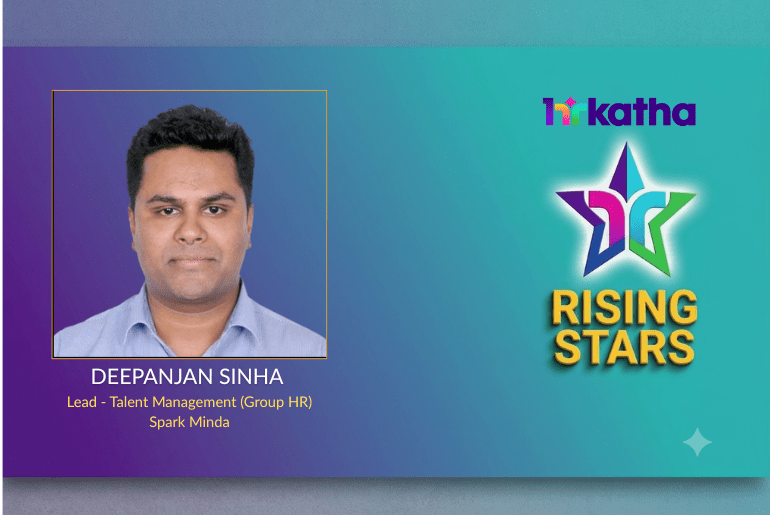
Winner | HRKatha Rising Star Leadership Award 2025
Every profession reaches a point when its role begins to change. For HR, that moment is now.
As artificial intelligence, shifting workforce expectations and persistent skill shortages reshape organisations, HR is moving well beyond hiring, payroll and policy. Increasingly, the function is expected to build organisational capability, influence business decisions and create cultures that can adapt to constant change.
Deepanjan Sinha belongs to a generation of HR professionals helping drive that transition. His work spans leadership development, competency frameworks, succession planning and organisation development, reflecting the broader shift taking place within the profession, one where emerging HR leaders are expected to be as comfortable discussing business performance and analytics as they are employee experience and culture.
His own motivation for entering HR stemmed from a simple observation. Products, technologies and business models can be replicated. Leadership capability, organisational culture and the quality of people cannot. That distinction continues to shape the way he approaches the profession.
Influence before authority
“Leadership isn’t defined by designation. It’s defined by influence,” says Sinha.
For him, leadership begins long before someone acquires a title. It starts when colleagues trust a person’s intent, value their judgement and willingly follow their lead. Formal authority may come later, but influence has already been earned.
That philosophy also shapes the advice he offers young HR professionals. Before attempting to solve people problems, they must first understand how the business creates value. HR becomes strategic only when it can connect people decisions with business priorities.
Credibility, he believes, is built less by having every answer than by asking the right questions, listening carefully and helping others succeed.
Business fluency, not just people skills
Ask Sinha what future HR leaders need most and he does not begin with empathy or communication. He begins with business.
Understanding commercial priorities and operational realities has become essential if HR professionals are to influence strategic decisions. Data literacy follows close behind: as AI, people analytics and digital platforms reshape hiring and workforce planning, intuition alone is no longer enough.
Yet Sinha is equally convinced that technology increases the value of distinctly human capabilities. As automation absorbs routine work, empathy, coaching and relationship-building become more important, not less.
The same thinking informs his view of culture. The workplaces he admires are not the ones with the best benefits or most visible engagement programmes, but those where leaders behave consistently with the values they promote. Trust grows when employees see alignment between words and actions, and feel safe enough to question, experiment and occasionally fail. Analytics and AI have changed how he works, shifting conversations from assumption to evidence and freeing up time for that human work. But their purpose, in his view, is to strengthen HR’s human core, not replace it.
When a good framework wasn’t enough
One of the most valuable lessons in Sinha’s career came from an initiative that appeared successful on paper. The framework was thoughtfully designed, conceptually sound and technically robust. Yet adoption across businesses and manufacturing plants proved slower than expected.
Looking back, he believes the team invested considerable effort in designing the solution but not enough in preparing the people expected to implement it.
Rather than designing solutions for the business and presenting them as finished products, he now prefers designing with the business. Stakeholders are involved early, ideas are piloted before wider implementation and feedback becomes part of the design process rather than something collected afterwards. Good frameworks, he learned, do not guarantee good outcomes. People do.
Measuring what changed, not what launched
Sinha is wary of equating activity with impact. Launching an HR initiative, he argues, is the easiest part. The more meaningful question is whether leaders make better decisions afterwards and whether employees experience tangible improvements in their everyday work.
He tracks leadership adoption, engagement, succession readiness and capability development, but ultimately judges them through business outcomes rather than HR metrics in isolation. His work on employee engagement illustrates the point: instead of treating surveys as an annual exercise, his team focused on converting feedback into action and strengthening leadership accountability, with the goal of building trust between employees and managers, not simply improving a score.
Looking ahead
Over the next decade, Sinha sees two equally compelling possibilities: leading the HR function for a business or global region at scale, or becoming a recognised specialist in talent management and organisation development, partnering across organisations rather than inside just one. Whichever path he follows, the underlying ambition stays the same, creating business impact through people.
He also believes the profession can do more to support emerging leaders, through greater exposure to strategic business discussions, cross-functional assignments, international projects and structured mentoring. Those opportunities, he argues, develop judgement far more effectively than classroom learning alone.
Quick Takes
Leadership in one line:
Leadership is the positive impact you create through consistency, collaboration and purpose.
HR thinkers he follows:
Leena Nair, Dave Ulrich, Josh Bersin and Simon Sinek.
An unpopular HR opinion:
Employee engagement is not HR’s responsibility alone. HR can create the ecosystem, but culture is shaped by leaders through their everyday decisions and behaviours.
Currently thinking about:
The shift from managing jobs to building skills, and what it means for hiring, learning and workforce planning.
Why he is a Rising Star
Deepanjan Sinha’s individual answers, taken alone, are not unusual. Business alignment, data literacy, empathetic leadership: most HR professionals at his level would say something similar if asked. What stands out is that the pattern holds across every part of his work, from how he defines leadership to how he measures success to how he responded to a rollout that didn’t go to plan. Business rigour and human judgement are treated as the same job rather than competing priorities, and it is that consistency, more than any single initiative, that the HRKatha Rising Star Leadership Award 2025 recognised in him.
His career is still unfolding. But it already reflects the direction the profession itself is moving in, away from transactional HR and towards organisations where business success and people success reinforce each other.
Rising Stars is HRKatha’s editorial series profiling the next generation of HR leaders shaping the future of the profession. The series features winners of the HRKatha Rising Star Leadership Awards alongside emerging professionals whose work, ideas and leadership potential deserve wider recognition.
