



Organisations are investing heavily in coaching. Coaches are multiplying rapidly. Employees across levels are being “coached” in some form or the other. The intent is clear.
But what happens after the coaching ends?

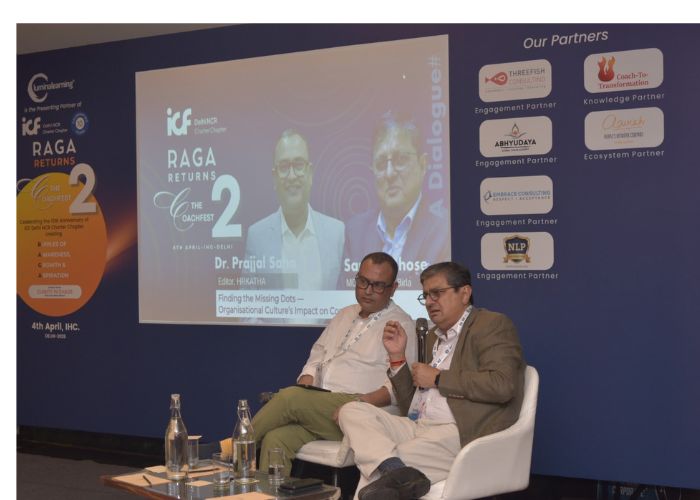
That question, posed by Prajjal Saha, founder and editor of HRKatha, set the tone for a sharp exchange with Sandip Ghose, CEO and MD, MP Birla Group, at the RAGA Returns, organised by the ICF Delhi NCR Chapter.
Saha framed the dilemma: when an individual returns after being coached, does the system accept the change? If not, what exactly is coaching solving?
Ghose responded from an operator’s lens. In many organisations, systems are not designed to absorb change at the same pace as individuals—creating a gap between transformation and acceptance.
The expectations gap
Ghose, who trained as a coach during the pandemic, described himself as “more of a customer” when bringing coaching into organisations.
For him, outcomes depend on clarity of expectations—not just for the individual being coached, but also for the organisation.
The individual expects change. The organisation expects visible impact. Unless both sides are aligned on what success looks like, there is no way to determine whether coaching has worked.
He also pointed to contextual differences. Coaching models, particularly those influenced by global frameworks, assume standardisation. In India, organisational realities vary widely, leading to disconnects in application.
From his experience, Ghose emphasised the need to clarify not just expected outcomes, but also what coaching cannot guarantee—because credibility depends on it.
Skills versus degrees
Saha drew attention to a persistent contradiction. Organisations emphasise skills and competencies, yet hiring decisions continue to prioritise degrees.
“How do you assess skills meaningfully in a one-hour interaction?” Prajjal Saha asked, questioning whether systems are equipped to evaluate what they claim to value.
The same concern, he suggested, applies to coaching. Are organisations clear about what kind of coaching they actually require? Do they have a firm grasp of the problem they are trying to solve?
The larger issue, he indicated, is clarity of organisational need. Without that, coaching risks becoming disconnected from real business requirements.
Ghose agreed, adding that coaching cannot be formula-driven. The effectiveness of coaching depends on selecting the right coach for the right context.
Behavioural coaching, for instance, requires psychological depth. In other cases, domain experience may be an unstated expectation from the coachee.
Real transformation, he indicated, depends on alignment between need, coach capability, and organisational intent.
Coaches or advisors?
Saha raised a structural question: when organisations engage coaches, are they actually looking for advisors?
The expectation, he suggested, often goes beyond facilitation to include guidance and expertise.
Ghose acknowledged this reality. Organisations, he said, expect a combination of experience, insight and knowledge—a “bouquet of expertise”.
While a single individual may not provide all of this, a collective approach can.
He also emphasised that effective coaching requires drawing from internal context and lived experience, not just frameworks.
In promoter-led organisations, the expectation is even more direct: what is the return on investment?
The market mismatch
Ghose pointed to a structural imbalance in the ecosystem.
“We are producing more coaches,” he observed. “But are we building enough organisational demand that knows how to use coaching effectively?”
In more mature markets, the demand for coaching is clearly identified and defined. In India, however, that demand is still evolving.
As a result, while the number of coaches is increasing, the corresponding organisational readiness is not keeping pace.
His suggestion was clear: the focus should shift towards developing the market for coaching, not just expanding its supply.
The celebrity problem
Saha brought in a parallel from his advertising days, recalling how clients often preferred working with names such as Piyush Pandey or Prasoon Joshi.
A similar pattern, he suggested, appears in coaching, where well-known names attract disproportionate attention.
Audience responses were mixed. Some believed celebrity coaches are relevant primarily at senior levels. Others pointed out that highly successful individuals often seek established names due to credibility considerations.
At the same time, a broader view emerged: organisations ultimately focus on outcomes. Reputation may matter, but only insofar as it signals proven results.
A former CHRO in the audience added that mature organisations evaluate coaches based on body of work, testimonials and track record—not just certifications. Networks and referrals also play a role.
The ROI illusion
Return on investment remains a widely used but loosely defined concept in coaching.
Saha questioned what organisations are actually measuring—behavioural change, business outcomes, or perception shifts.
Ghose responded that while organisations expect impact, coaching outcomes are not always linear or immediately measurable.
He also pointed out that credibility plays a significant role in coaching engagement, particularly at senior levels. Individuals often seek coaches based on experience and track record rather than certification.
At the same time, he acknowledged that coaching investments are more common at senior levels, where alignment with business outcomes is clearer.
The missing question
What emerged from the discussion was a deeper structural concern.
Saha’s central question remained: organisations are investing in changing individuals, but are they prepared to change themselves?
Ghose’s observations reinforced the same concern. Systems are often not equipped to absorb the change they initiate.
Until organisations define expectations clearly, align them with the right coaching interventions, and prepare themselves to accept transformed individuals, the coaching boom may remain uneven in its impact.
The real challenge is not producing better coaches.
It is building systems that are ready for them.