



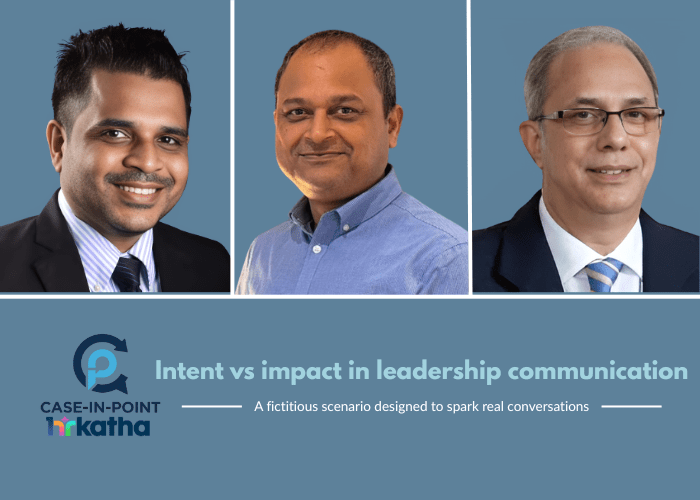
HRKatha’s Case-in-Point presents real-world HR dilemmas and invites leaders to weigh competing business and ethical choices.
Company: Unified Dynamics (fictitious), a Rs 2,000 crore conglomerate operating in FMCG, retail, and logistics

Background
Unified Dynamics recently held its quarterly town hall, attended virtually by 8,000 employees. The agenda covered business performance, strategic priorities, and an open Q&A.
The situation
During the Q&A, an employee asked:
“Our DEI report shows women hold only 12 per cent of leadership roles. What are we doing to change this?”
The CHRO, Ritesh Deshmukh, responded:
“We are committed to diversity, but we also have to be realistic. Leadership roles require long hours, travel, and tough decisions. Not everyone, male or female, is willing to make those sacrifices. We promote based on merit and availability, not quotas.”
Within an hour, backlash began.
An employee wrote on the internal platform:
“Did the CHRO just say women aren’t in leadership because they’re not willing to sacrifice?”
The post drew over 200 reactions. Comments followed. Women leaders shared instances of being passed over despite long hours. The women’s employee resource group wrote to the CEO seeking a public apology.
Their message was direct: the statement reflected bias and undermined the company’s credibility on inclusion.
The CEO forwarded the note to HR.
Ritesh remained firm: “I didn’t say women don’t sacrifice. People are twisting my words. I’m not apologising for something I didn’t mean.”
Sentiment across the organisation is largely against him. Some senior women leaders have indicated they may resign.
HR now faces a difficult choice.
The dilemma
Should HR advise a public clarification, acknowledging the impact of the statement?
Or support the CHRO’s position that intent matters and the reaction is a misinterpretation?
What’s really at stake
This is a test of leadership accountability in a world where every word is amplified instantly.
If Ritesh apologises, he may be seen as conceding to pressure. If he doesn’t, the organisation risks losing trust, credibility, and possibly key talent.
The deeper tension is harder to ignore: when does accountability for impact begin to suppress honest, if imperfect, expression?
What HR leaders said
Rajeev Singh, CHRO, Yokohama ATG
“The response was poorly framed for a public forum. The question was about representation, but the answer shifted to sacrifice and availability.
That said, I would not rush to a public apology. The organisation should clearly reinforce its commitment to equal opportunity. That message should come institutionally.
A clarification from the CHRO explaining the broader context may be sufficient if there was no discriminatory intent.
We must also be careful not to create an environment where every misstep demands a public apology. That risks making leaders overly cautious.
This is a reminder that leaders must be far more deliberate with language, especially in large forums.
Not every communication error requires an apology. Sometimes, clarity and institutional reassurance are enough.
Satyajit Mohanty, Senior HR leader
“For me, this is about impact, not intent.
Employees respond to what they hear, not what leaders mean. Once words are recorded and shared, perception becomes reality.
Some form of public clarification is necessary. It does not have to be dramatic, but it must acknowledge that the statement caused discomfort.
The bigger risk is not reputational for the CHRO. It is cultural for the organisation. If employees begin to question whether inclusion is taken seriously, trust erodes.
Ignoring the issue or waiting for it to pass is not a solution.
If diversity is a genuine priority, accountability must be visible.
Leaders must recognise that impact carries more weight than intent, especially on sensitive issues.
Chandrasekhar Mukherjee, Senior HR leader
“The communication could certainly have been better, but I do not see deliberate bias.
Leaders must be mindful not just of what they say, but where and how they say it. A town hall is not the place for loosely framed responses on sensitive topics.
The CEO’s role is critical here. If there was no intent to discriminate, leadership should respond collectively, not isolate the CHRO.
A timely clarification from the CEO could have addressed the situation and prevented escalation.
Such reactions rarely stem from a single comment. They often reflect underlying trust gaps.
This is less about one statement and more about how leadership responds under pressure.
Handled well, it can restore trust. Handled poorly, it can deepen existing fractures.
If you were the CHRO at Unified Dynamics
What would you do?
- Ask for a public clarification acknowledging impact
• Have the CEO step in and reset the narrative
• Stand by intent and avoid an apology
Or is the real question this:
Does leadership accountability depend on intent or on impact?
Share your view in the comments or on LinkedIn using #HRKathaCaseInPoint.
1 Comment
When did apologizing and explaining to improve communication become a liability? Big mistake but easy to fix.