


Company: BrightFuture Consulting (fictitious), a mid-sized management consultancy with 900 employees, advising clients across financial services, infrastructure, and consumer sectors.
Background
Rhea Mathur has been with BrightFuture for five years. She joined as an analyst, earned two promotions, and now leads a six-member strategy team working on some of the firm’s largest client mandates. Her last two performance reviews were exceptional. Her manager, Vikram Sood, considers her one of the strongest people in his division.
Three weeks ago, Vikram noticed something on LinkedIn.
Rhea had turned on “Open to Work”. Her profile had been updated with a sharper summary, newly added certifications, and a visible green banner that recruiters and colleagues alike could see. Over the following weeks, she began engaging publicly with posts from competing firms and responding to recruiter comments.
Her work, however, remained unchanged. Deliverables were on time. Clients had no complaints. Her team described her as fully present and engaged.
Still, Vikram was unsettled.
He walked into HR with a request: “Can someone speak to her? I think she’s mentally checked out, and I’d rather address it now than lose her quietly.”
HR now faces a difficult choice.
The dilemma
Should HR proactively reach out to Rhea, treating her visible job search as a signal worth addressing and exploring whether unresolved concerns, growth opportunities, or retention conversations could change her trajectory?
Or should HR decline Vikram’s request, maintaining that career exploration is a personal matter and intervening only if her performance actually declines?
What’s really at stake
This is a test of where employee privacy ends and organisational interest in retention begins.
Rhea has done nothing wrong. She has not resigned, disengaged, or spoken to clients about leaving. She has updated a professional profile, something millions of employees do every day.
And yet her manager now wants HR to intervene.
The risk of acting is real. If Rhea discovers that her LinkedIn activity triggered internal concern, she may feel watched rather than supported. The very intervention meant to retain her could reinforce her desire to leave.
But the risk of not acting is equally real. If something is genuinely pushing her to look elsewhere – unmet ambitions, stalled growth, or a ceiling she no longer believes she can break through – the organisation may lose her simply because nobody asked.
The deeper question is harder to avoid: in a world where career exploration is publicly visible by default, has the old boundary between professional ambition and workplace loyalty quietly disappeared?
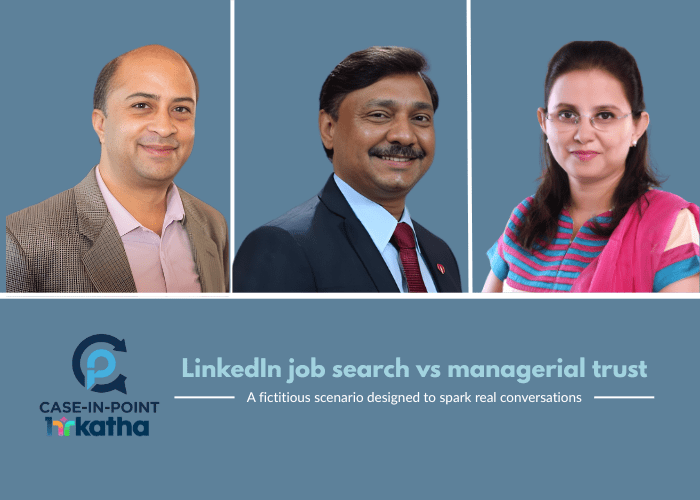
We asked three HR leaders how they would approach this dilemma.
What HR leaders said
Sailesh Menezes, former vice president & head-HR – APJ, HPE
“My first instinct would be to ask whether the organisation is responding out of genuine concern or reacting out of fear. Organisations are built on trust, not surveillance. An employee publicly signalling openness to opportunities does not automatically mean disengagement or reduced commitment.

People explore careers for many reasons: growth aspirations, compensation expectations, or long-term professional alignment. None of these is a failing.
As HR leaders, our role should not be to single out individuals because their job-search activity happens to be visible. The better approach is to build a culture where regular conversations about engagement and aspiration already happen – not because someone updated LinkedIn, but because good managers stay connected to their people.
The moment we approach someone as though they have done something wrong, we risk damaging the very trust we are trying to protect. Ironically, the intervention intended to retain talent can end up confirming every reason they had for looking elsewhere.
In this case, I would encourage Vikram to have a genuine career conversation with Rhea – not because of LinkedIn, but because that is what strong managers do. HR should resist making employees feel watched.”
Naresh Kumar Puritipati, CHRO, Lactalis India
“Employees exploring opportunities is not a betrayal. It is today’s market reality.
In an era where platforms such as LinkedIn make professional ambition visible by default, leaders should not treat every ‘Open to Work’ signal as a crisis.

The real question for HR is not what Rhea is doing on LinkedIn. It is what BrightFuture has or has not done to make staying the more compelling choice. Have we created enough meaning, growth, fairness, and psychological safety for high performers to want to build their careers here?
If one person signals openness, that may be individual. If the same pattern appears across strong performers, then it becomes an organisational signal and deserves leadership attention.
In this case, rather than focusing narrowly on Rhea, I would encourage HR to examine the broader picture. Are growth paths credible? Are strong performers finding enough challenge? Is the culture enabling or quietly stifling ambition?
‘Open to Work’ often reveals less about employee loyalty and more about whether the organisation has kept pace with what its best people need.”
Anju Jumde, CHRO, Aditya Birla Money
“I have encountered situations very similar to this. Managers often ask whether HR should speak to the employee, or whether they should. My response has consistently been the same: not in the sense of confronting someone about LinkedIn activity.

As long as performance is unaffected, career exploration is a personal prerogative. Treating it otherwise sends a chilling message.
What should concern us instead is whether we are doing enough to engage high performers. Are there development opportunities Rhea is not seeing? Is there a growth conversation that has been delayed or left vague? Could a clearer path forward change her outlook?
At the same time, organisations must accept an uncomfortable reality: managers cannot become owners of talent. High performers are ambitious and marketable by nature. They will always attract outside interest.
There is, however, another risk that often goes unspoken. Managers who feel threatened by an employee’s visible job search sometimes begin – consciously or unconsciously – to penalise that person. Ratings shift. Opportunities narrow. Conversations become colder. HR has a responsibility to watch for exactly this.
Rhea’s ambition must never become the reason her next performance review looks different.”
If you were the CHRO at BrightFuture
You have been asked to advise Vikram and recommend a course of action to the leadership team.
Do you:
- Encourage Vikram to have a genuine career conversation with Rhea, without referencing LinkedIn?
- Initiate a formal retention discussion, acknowledging that her visible job search triggered concern?
- Step back from the individual case and examine whether broader engagement issues exist across the division?
Or is the deeper question this:
If organisations only start listening once ambition becomes publicly visible, have they already lost trust?
Share your perspective in the comments or on LinkedIn using #HRKathaCaseInPoint