
Close Menu
    Facebook X (Twitter) Instagram
    • Our Story
    • Partner with us
    • Reach Us
    • Career
    Subscribe Newsletter
    HR KathaHR Katha
    • Exclusive
      • Exclusive Features
      • Perspectives
      • Friday Features
      • herSTORY
      • Case-In-Point
      • Point Of View
      • Research
      • HR Pops
      • Dialogue
      • Movement
      • Profile
      • Beyond Work
      • Rising Star
      • By Invitation
    • News
      • Global HR News
      • Compensation & Benefits
      • Diversity
      • Events
      • Gen Y
      • Hiring & Firing
      • HR & Labour Laws
      • Learning & Development
      • Merger & Acquisition
      • Performance Management & Productivity
      • Talent Management
      • Tools & Technology
      • Work-Life Balance
    • Special
      • HR Forecast 2026
      • Cover Story
      • Editorial
      • HR Forecast 2024
      • HR Forecast 2023
      • HR Forecast 2022
      • HR Forecast 2021
      • HR Forecast 2020
      • HR Forecast 2019
      • New Age Learning
      • Coaching and Training
      • Learn-Engage-Transform
    • Magazine
    • Reports
      • Whitepaper
        • HR Forecast 2024 e-mag
        • Future-proofing Manufacturing Through Digital Transformation
        • Employee Healthcare & Wellness Benefits: A Guide for Indian MSMEs
        • Build a Future Ready Organisation For The Road Ahead
        • Employee Experience Strategy
        • HRKatha 2019 Forecast
        • Decoding and Driving Employee Engagement
        • One Platform, Infinite Possibilities
      • Survey Reports
        • Happiness at Work
        • Upskilling for Jobs of the Future
        • The Labour Code 2020
    • Conferences
      • Leadership Summit 2025
      • Rising Star Leadership Awards
      • HRKatha Futurecast
      • Automation.NXT
      • The Great HR Debate
    • HR Jobs
    WhatsApp LinkedIn X (Twitter) Facebook Instagram
    HR KathaHR Katha
    zoha
    Home»Exclusive Features»Friday Features»The workplace fears people are finally starting to lose
    Friday Features

    The workplace fears people are finally starting to lose

    From speaking up in meetings to admitting uncertainty, professionals are becoming far less willing to stay silent
    mmBy Radhika Sharma | HRKathaJune 5, 20265 Mins Read285 Views
    Share LinkedIn Twitter Facebook WhatsApp
    workplace fears
    Share
    LinkedIn Twitter Facebook WhatsApp

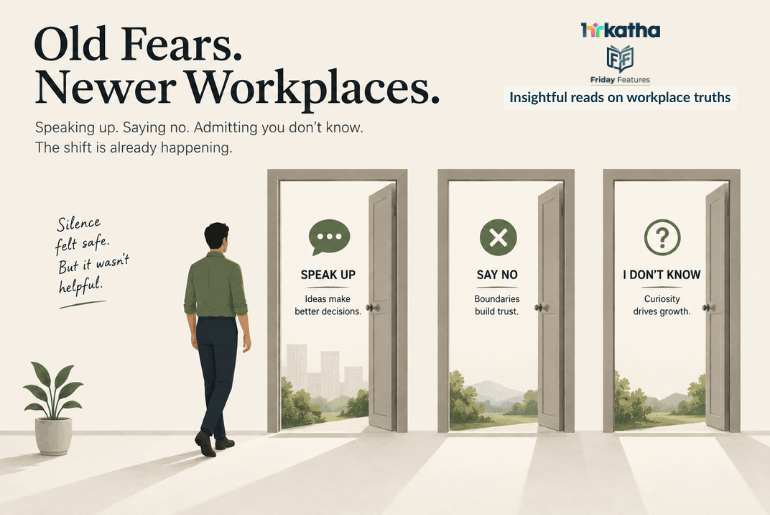
    Every workplace runs on two sets of rules. The official ones, written down somewhere and largely ignored. And the unofficial ones, which nobody writes down but everybody follows.

    For years, those unofficial rules came with a familiar set of anxieties. Speak up and look presumptuous. Disagree with the manager and risk your prospects. Admit you do not know something and appear incompetent. Most professionals carried at least one of these quietly, whilst assuming everyone else in the room was entirely comfortable.

    zoha

    That assumption, it turns out, was wrong. And slowly, so are some of the fears.


    The hesitation around speaking up

    Nitin Khindria, Group CHRO, Omega Group

    Think back to the early years of almost any career. You walk into a meeting with an idea, notice three senior leaders across the table, and quietly decide the idea is probably not worth sharing.

    So you nod. You take notes. You agree with decisions you are not entirely convinced by.

    Nitin Khindria traces this partly to how organisations were once built. Hierarchies were sharper. Information was limited. Employees focused largely on the tasks directly in front of them and understood little about what happened beyond their own function.

    zoha

    That has changed considerably.

    Today, employees have far greater visibility into how businesses actually work: customer expectations, market pressures, and how different teams connect with one another. And that visibility, Khindria argues, creates something important  — a sense of ownership beyond the job description.

    “When you have a lot of information available to you,” he says, “you feel that you are part of that particular project, team, vision and mission of the organisation.”

    The junior employee asking a tough question during a town hall. The engineer challenging a product feature because customers may not need it. These are not acts of unusual confidence so much as acts of engagement. People who understand the bigger picture find it harder to stay silent about it.

    The fear of raising a hand has not disappeared. But the logic for staying quiet is becoming harder to defend.


    Why saying no still feels risky

    Ashish Sharma, seasoned HR professional

    Most professionals can recall the moment precisely. A manager asks for one more assignment despite an already overloaded schedule. A deadline feels unrealistic. A decision seems flawed. And yet the answer, almost automatically, is yes.

    Not because they agree. Because no still feels dangerous.

    Ashish Sharma believes this remains one of the most persistent workplace anxieties. “Most of the time, people are not able to say no to their managers,” he says, “even when their managers are not right.”

    The hesitation, he suggests, is rooted in trust, or the absence of it. Employees worry disagreement may be mistaken for defiance. That pushing back could affect relationships, future opportunities, or perceptions of commitment.

    So they stay silent. And silence tends to make things worse.

    People take on more than they can realistically deliver. Teams continue with flawed decisions simply because nobody challenged them early enough. Managers repeat avoidable mistakes because honest conversations never happen.

    Sharma’s point is not that employees should become argumentative. It is simpler than that: organisations function better when people can express concerns respectfully, and leaders remain genuinely open to hearing them.

    Handled well, disagreement is not disrespect. It is often how better decisions get made.


    The pressure to always appear informed

    Anil Mohanty, Group CHRO, Falcon Group

    There is another workplace fear that disguises itself as confidence.

    An unfamiliar term appears in a meeting. A new technology is referenced that everyone else seems to understand. A business concept comes up that you have never encountered before.

    Rather than ask, you take careful notes and promise yourself you will look it up later.

    Anil Mohanty has noticed a quiet but meaningful shift here too. Employees are becoming more willing to acknowledge what they do not know, and more comfortable asking for help when they need it.

    His view is straightforward: the most effective professionals are not necessarily the most informed people in the room. They are the ones most willing to keep learning. In industries evolving faster than most training programmes can keep up with, curiosity matters more than performed expertise.

    There is also a small comfort worth remembering: most people in the room are not judging the person who asks the basic question. More often, they are quietly relieved someone finally did.


    What is actually changing

    Workplace fears are not disappearing. There will always be moments when speaking up feels uncomfortable, pushing back feels risky, or admitting uncertainty feels exposing.

    But the logic that once kept people silent is becoming harder to sustain. More visibility and more interconnected teams have changed how contribution is perceived. Perhaps the shift is not really about confidence at all. It is about people gradually realising that staying quiet was never as safe as it seemed.

    Which of these workplace fears do you recognise most, and what helped you move past it?

    Share in the comments.

    Culture diversity Employee Employee Benefits Employee Engagement employees employer Employment Engagement Human Resources LEAD Productivity Recruitment Skill Development Training Workforce Workplace workplace fears
    Share. LinkedIn Twitter Facebook WhatsApp
    mm
    Radhika Sharma | HRKatha

    Radhika is a commerce graduate with a curious mind and an adaptable spirit. A quick learner by nature, she thrives on exploring new ideas and embracing challenges. When she’s not chasing the latest news or trends, you’ll likely find her lost in a book or discovering a new favourite at her go-to Asian eatery. She also have a soft spot for Asian dramas—they’re her perfect escape after a busy day.

    Leave A Reply Cancel Reply

    Related Posts

    Ranjeet Singh promoted to CHRO, Enpro Industries

    June 5, 2026

    ASK promotes Stanley to associate director & head-HR, wealth & international businesses

    June 5, 2026

    EU risks losing 1.3 mn jobs as energy prices climb after US-Iran conflict

    June 5, 2026

    CIBC to establish Hyderabad GCC, creating 2,000 jobs

    June 5, 2026
    Editorial

    The knowledge that retires before the person does

    The logic behind retirement at 60 once made sense. India was younger. Jobs were scarce.…

    The new power map inside HR

    The org chart did not predict this shift. Business urgency did. Corporate HR structures still…

    EDITOR'S PICKS

    The workplace fears people are finally starting to lose

    June 5, 2026

    Case-in-Point: Capability vs credibility

    June 4, 2026

    herSTORY: Sonali De Sarker, SVP-HR, Epsilon India

    June 4, 2026

    HR Perspectives by Raj Narayan: “Leadership commitment is the starting point to both meritocracy and inclusion”

    June 3, 2026
    Latest Post

    The workplace fears people are finally starting to lose

    Friday Features June 5, 2026

    Every workplace runs on two sets of rules. The official ones, written down somewhere and…

    Ranjeet Singh promoted to CHRO, Enpro Industries

    Movement June 5, 2026

    Pune-based Enpro Industries has promoted Ranjeet Singh to chief human resources officer (CHRO). Before being…

    ASK promotes Stanley to associate director & head-HR, wealth & international businesses

    Movement June 5, 2026

    After eight years of association with ASK Asset & Wealth Management, Vincent Stanley has been…

    EU risks losing 1.3 mn jobs as energy prices climb after US-Iran conflict

    Global HR News June 5, 2026

    The European Union (EU) may lose up to 1.3 million jobs this year because energy…

    Asia's No.1 HR Platform

    Facebook X (Twitter) Instagram LinkedIn WhatsApp Bluesky
    • Our Story
    • Partner with us
    • Career
    • Reach Us
    • Exclusive Features
    • Cover Story
    • Editorial
    • Dive into the Future of Work: Download HRForecast 2024 Now!
    © 2026 HRKatha.com
    • Disclaimer
    • Refunds & Cancellation Policy
    • Terms of Service

    Type above and press Enter to search. Press Esc to cancel.