



Employee benefits once followed a simple bargain: pay people reasonably well and they would work. Healthcare coverage, provident fund contributions, perhaps a subsidised canteen. The rest was considered personal life.
Amazon India’s approach starts from a different premise. “The employee is an internal customer, because unless an employee is happy, there is no way our customers are going to be happy,” says Shantanu Chakraborty, director of HR and people experience, Amazon India. The company applied its customer-obsession philosophy inward, designing benefits by working backwards from employee realities much as it would for external consumers.

That exercise revealed something obvious but often ignored: employees do not arrive at work alone. Children, ageing parents, financial anxieties, fertility treatment, and mental health pressures arrive with them. A benefits strategy focused only on the individual employee misses much of what shapes performance.
“Employees are not a standalone unit in themselves. If we truly want to support them, we have to understand and support the families, responsibilities and realities that shape their lives.”
Shantanu Chakraborty, director-HR and people experience, Amazon India

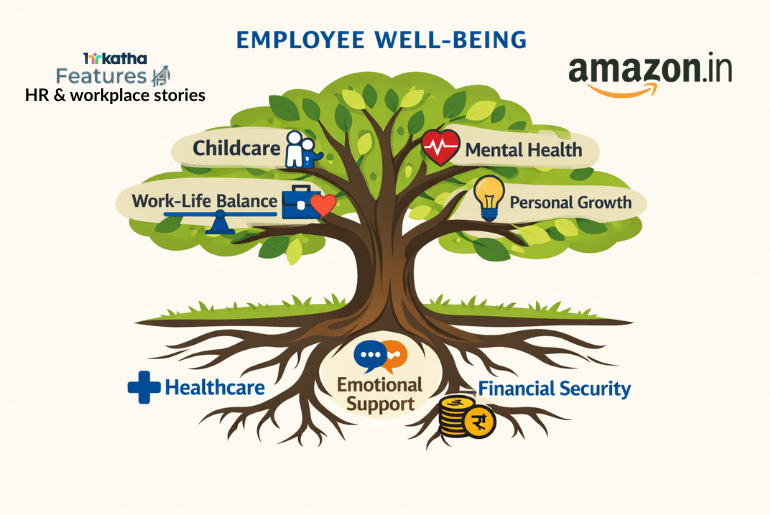
The result is an unusually expansive framework. Amazon India offers fertility and surrogacy support, gender reassignment surgery coverage, counselling for employees’ children up to age 17, childcare partnerships, financial wellness programmes, and flexible benefits employees can tailor to personal circumstances.
Amazon does not disclose comparative retention or productivity data, making it difficult to judge whether the broader framework materially outperforms more conventional benefits structures. But the philosophy itself reflects a wider shift among large employers competing for skilled talent: well-being is increasingly treated as infrastructure rather than a perk.
Built in, not bolted on
One distinction Chakraborty returns to repeatedly is the difference between benefits that are “built in” and those merely “bolted on”.
Benefits covering fertility treatment, surrogacy, or gender reassignment surgery are often presented by companies as progressive additions responding to changing workforce expectations. Amazon frames them differently. “The reality is they were always there,” Chakraborty says. Employees had these needs long before employers formally acknowledged them.
That distinction matters because programmes added as afterthoughts often become underused resources employees neither understand nor trust. Embedding support into broader care frameworks, and treating such needs as ordinary rather than exceptional, potentially reduces the stigma that prevents utilisation in the first place.
Whether employees actually feel comfortable using these benefits remains harder to determine. Many companies discover that their most progressive offerings are also their least-used ones.
When discovery became the problem
Designing benefits proved easier than ensuring employees knew they existed.
Amazon encountered repeated situations where employees struggled with challenges for which support was already available, including childcare, fertility treatment, and mental health support, yet remained unaware of the resources. A benefit that remains undiscovered cannot create impact.
The company responded by turning discovery into a system rather than assuming employees would find support themselves. One outcome was Aza, an AI-enabled interface allowing employees to explore policies and support privately and at their own pace.
Privacy matters particularly for sensitive issues. Employees may hesitate to discuss fertility treatment, counselling, or gender reassignment directly with managers or HR teams. Digital access lowers some of that friction.
Extending benefits beyond employees
Amazon’s more distinctive shift lies in extending well-being support beyond employees themselves.
Mental health support now covers employees’ children up to age 17. Childcare partnerships emerged after the company discovered that employees cared less about office-based crèches than proximity to home. “Parents wanted solutions closer to home and integrated more naturally into their daily lives,” Chakraborty says.
The insight sounds simple but reflects a broader problem with many corporate childcare models. Employers often build facilities around office campuses, whilst employees organise childcare around homes, schools, and commuting realities. The company responded by partnering with external daycare providers across locations rather than concentrating facilities inside offices.
Its financial wellness programme, Samridhi, evolved similarly. Employees were less interested in investment products than in navigating practical life questions: children’s education, retirement planning, tax-efficient saving, and long-term financial security.
Flexibility and complexity
Amazon’s MyFlex platform allows employees to tailor benefits as circumstances change. Younger employees may prioritise healthcare coverage for parents. Others may focus on fertility treatment or childcare. Employees later in their careers may prioritise retirement planning.
The philosophy is straightforward: benefits should adapt to employees rather than expecting employees to adapt to fixed structures.
The flexibility sounds attractive. It also assumes employees can navigate increasingly complex choices. Workers who are financially literate or comfortable engaging with HR systems may benefit disproportionately, whilst others risk remaining underinsured or under-supported despite having broader options available.
Flexible benefits sound progressive. In practice, they often shift decision-making complexity onto employees least equipped to navigate it, widening rather than narrowing benefit gaps.
Psychological safety as infrastructure
Amazon increasingly frames well-being around three ideas: awareness, accessibility, and normalisation.
The first ensures employees know what exists. The second makes support easier to access. The third may be the hardest: creating an environment where employees feel comfortable using it.
This is where managers become critical. Chakraborty says the company invests in sensitising managers to respond empathetically and direct employees towards support systems appropriately.
Research consistently shows that manager behaviour predicts whether employees use available support more reliably than programme design or communication quality. A single dismissive response from a manager can render even the most comprehensive support system irrelevant.
Whether that consistency exists across a large organisation is more difficult to assess. Culture rarely operates uniformly at scale.
Listening as operating model
Underlying many of Amazon’s initiatives is Connections, a continuous employee-feedback mechanism designed to capture shifting needs and experiences.
The company frames well-being less as a fixed programme and more as an evolving operating system. Employees’ expectations change. Family structures change. Financial pressures change. Benefits designed for one workforce generation may not suit the next.
The more important question is whether listening mechanisms actually alter decisions. Collecting employee sentiment is relatively easy. Demonstrating that feedback changes policies is harder.
The broader shift
Amazon India’s approach reflects a broader shift in corporate thinking: employees are increasingly treated less as workers and more as ecosystems of financial, emotional, and family responsibilities.
The model is ambitious. It is also expensive, administratively complex, and easier for large technology firms than for most employers.
Still, the underlying logic is difficult to dismiss. If work increasingly absorbs emotional and cognitive bandwidth, employers may find that supporting employees alone is no longer sufficient. The pressures shaping performance often originate outside the workplace altogether.
Whether such expansive benefit models become mainstream corporate practice or remain concentrated among well-capitalised firms will become clearer when economic conditions tighten and benefit budgets come under greater scrutiny.