



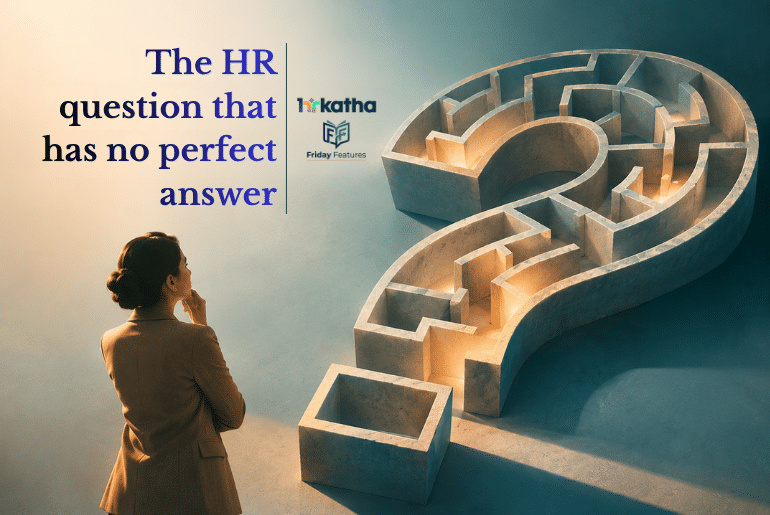
There are questions at work that HR can answer cleanly. And then there are the others. Why didn’t I get promoted? Why does my colleague earn more? Why can she work from home and I can’t? Why wasn’t I recognised? Why was my role made redundant?
Employees understandably ask these questions expecting a straightforward response. HR often has to give them something closer to a paragraph. That is not necessarily evasion. The honest answer usually involves context, history, business need and a definition of fairness that may not mean the same thing to everyone in the room.
Three HR leaders reflect on what makes these conversations difficult, and what an honest answer should contain when there is no answer everyone will like.
“Why wasn’t I told sooner?”
Viekas Khokha, G-CHRO, Sharda Motor Industries
Some of the hardest HR questions are uncomfortable not because the answer is difficult to find, but because somebody has spent too long avoiding giving it.

Viekas Khokha points to a pattern that plays out regularly in organisations. A manager can see that an employee is struggling, that the work is falling short or that something needs to change. Yet the conversation keeps getting postponed. The timing never seems quite right and the message feels too uncomfortable to deliver directly, so feedback is softened until the employee can no longer tell that there is a problem.
The consequence appears much later. By the time the situation can no longer be avoided, the employee is blindsided. They believed they were doing reasonably well while the manager had been quietly concerned for months. At that point, “Why wasn’t I told sooner?” is not merely an emotional response. It is a legitimate question about whether the organisation gave the employee a fair opportunity to understand the problem and respond to it.
Khokha’s argument is not that managers need to become brutal. Difficult feedback can be delivered with care and still retain its meaning. What matters is that concern is communicated while there is still something useful the employee can do with it, rather than appearing for the first time when a consequential decision has already been made.
He also points to recency bias as another way fairness can become distorted. One poor presentation, missed deadline or difficult incident can loom disproportionately large in a manager’s memory. A fair assessment requires the longer view. If someone has done a hundred things well and one thing badly, the most recent failure should not quietly become the entire performance record.
You don’t have to like the answer
Pradyumna Pandey, Senior HR Leader & CEO, Promediexcel Learning
Pradyumna Pandey offers a useful frame for these conversations: employees do not need to be happy with every organisational decision, but they do deserve to understand the reasoning behind it.

Someone can disagree with an outcome and still recognise that there was a logic to how it was reached. What often creates more lasting resentment is the sense that a decision arrived from nowhere, that the criteria changed somewhere along the way or that nobody considered the employee important enough to explain what happened.
That distinction matters because the answers to difficult workplace questions are rarely satisfying in the way employees hope. A promotion may not happen because the larger role does not yet exist or the employee is not ready for its demands. A particular job may require more physical presence than another. Compensation may reflect a combination of performance, market benchmarks, internal parity and organisational constraints rather than the single factor an employee is looking at. None of those explanations guarantees agreement, but each gives the employee something concrete to understand and respond to.
That is different from trying to make an unpopular answer sound pleasant. Clarity can occasionally disappoint people more quickly, but ambiguity tends to frustrate them for much longer. An honest explanation treats the employee as someone capable of hearing an answer they may not like.
“But why does she get to?”
Pallavi Poddar, CHRO, Knauf India
Pallavi Poddar’s responses to two common workplace questions, around promotion and flexibility, rest on the same distinction: fairness does not necessarily mean identical treatment.

On promotion, her position is direct. Tenure alone is not the criterion. The role needs to have grown, the employee needs to be handling greater responsibility and complexity, and there has to be an organisational requirement for the larger role to exist. That changes the question from “How long have I been here?” to “How has my contribution expanded?”, which gives both employee and organisation something more substantive to discuss.
The same principle applies to flexibility. When an employee sees a colleague working from home more frequently and asks why, the answer may involve several factors: the nature of the role, the deliverables involved, the circumstances and the manager’s confidence that the arrangement is working. Those factors can differ between employees, which means the outcomes can differ too.
This is where equality and fairness become easy to confuse. Equal treatment gives everyone the same thing. Fair treatment requires relevant differences to be considered consistently. From the employee’s side of the desk, however, only the visible outcome may be available for comparison. They can see that a colleague received something they did not; they cannot necessarily see all the information behind either decision.
That places an additional burden on HR. It is not enough for a decision to have been carefully considered. Where possible, the reasoning also needs to be explained clearly enough for employees to understand the principles being applied, without disclosing another employee’s confidential circumstances. Agreement may still be elusive. Understanding should not be.
The question behind the question
The hardest HR questions are rarely only about promotion, flexibility, performance or compensation. Beneath them sits something more personal: did the organisation see me, was this decision genuinely considered, and are the rules being applied in a way I can understand?
HR cannot make every decision feel fair to every employee. Nor can complete transparency always be the answer, particularly when another person’s circumstances are part of the comparison. What it can do is apply criteria consistently, communicate concerns before they become consequences and explain difficult decisions without treating the employee’s question as an inconvenience.
Perhaps that is why the best answer to a difficult HR question is not necessarily the one that ends the argument. It is the one that leaves the employee understanding how the organisation arrived where it did, even when they would have preferred it to arrive somewhere else.
What is the hardest question you have ever had to answer at work, on either side of the table? Share it in the comments.