



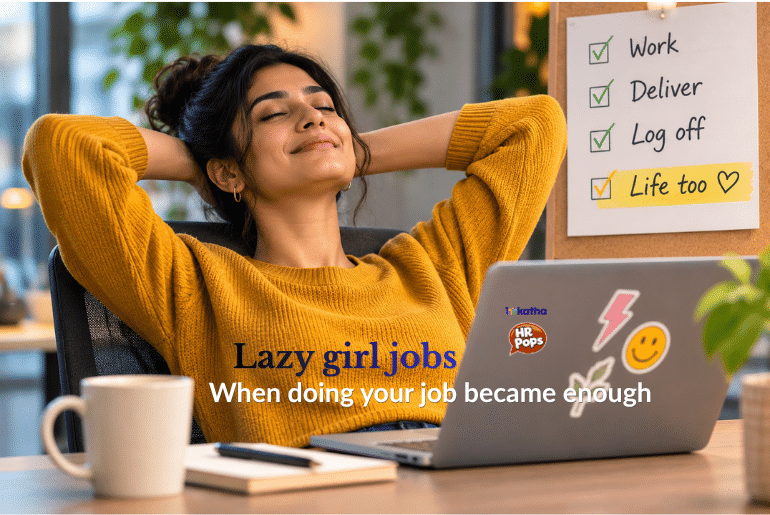
What does a ‘Lazy girl job’ mean?
A job with reasonable hours, manageable expectations, predictable responsibilities and enough flexibility to have a life outside work. For many employees, that sounds like a perfectly sensible arrangement. On social media, it acquired a more provocative name: the lazy girl job.
The phrase describes work that provides financial stability without demanding constant availability, excessive emotional investment or a willingness to sacrifice personal time for professional advancement.
Despite the name, it does not necessarily imply avoiding responsibility. The attraction lies in being able to perform a job competently without allowing it to consume the rest of one’s life.
The distinction matters. A manageable job is not automatically an unproductive one. Nor is an exhausting job necessarily more valuable.
Where did the idea come from?
The expression gained widespread attention in 2023 through TikTok creator Gabrielle Judge, who popularised the idea of relatively well-paid, low-stress jobs with predictable hours and limited demands beyond the working day.
The phrase was deliberately provocative. By describing such work as ‘lazy’, it challenged a culture in which professional ambition had become closely associated with overwork.
Its popularity also reflected a wider reassessment of employment following the pandemic. Remote working had changed expectations about flexibility, while experiences of burnout and blurred work-life boundaries had prompted many employees to reconsider how much of themselves they wanted to invest in their jobs.
The trend belonged to the same broader conversation as quiet quitting and the rejection of hustle culture. But it carried a slightly different message.
Rather than simply questioning discretionary effort, it questioned whether career advancement should remain the defining measure of a successful working life.
Why is it relevant for HR?
The phrase offers HR a useful way to examine job design.
When predictable hours and manageable workloads become selling points, organisations should ask whether their ordinary expectations have drifted too far in the opposite direction.
Many jobs accumulate responsibilities without shedding older ones. Meetings multiply, reporting requirements expand and digital communication makes employees accessible long after formal working hours end. The resulting pressure is not always evidence that the work itself has become more demanding. Sometimes it reflects how poorly that work is organised.
The lazy girl job conversation also challenges how performance is recognised. In workplaces where visible busyness is mistaken for commitment, an employee who completes assignments efficiently and leaves on time may appear less dedicated than a colleague who remains constantly available.
That creates a peculiar incentive: employees can gain recognition for the appearance of effort rather than the value of their contribution.
There is a gender dimension too. The phrase emerged in conversations shaped partly by women’s experiences of balancing paid employment with domestic and caregiving responsibilities. Its appeal cannot be separated entirely from the unequal demands placed on people’s time outside work.
For HR, the question is whether organisations are designing jobs around reasonable expectations or assuming that employees have unlimited capacity to accommodate work.
The uncomfortable truth
The trend can be misread in two directions.
One is to dismiss it as evidence that younger employees lack ambition. That overlooks the possibility that people are rejecting particular forms of work rather than work itself.
The other is to romanticise jobs that make few demands. Predictability and low stress can be valuable, but they do not automatically produce fulfilling careers. Some employees may eventually find that limited challenge also means limited learning, influence or progression.
The more important distinction is between sustainable work and stagnant work.
A role can offer reasonable boundaries while remaining intellectually demanding. Employees can be committed to their responsibilities without making professional advancement their overriding priority.
Organisations, meanwhile, still need performance standards, accountability and people willing to develop new capabilities.
The challenge is to preserve those expectations without treating exhaustion as proof of commitment.
The takeaway
Lazy girl jobs became a talking point because the phrase exposed a contradiction in modern employment. Many organisations say they value efficiency, yet their cultures continue to reward long hours, constant availability and visible busyness.
For HR, the useful response is neither to endorse the label nor to ridicule it. It is to examine what employees are actually asking for: work that is meaningful, fairly rewarded and sustainable.
The more revealing question may be why a job that allows someone to do good work and still have a life came to be described as lazy.