


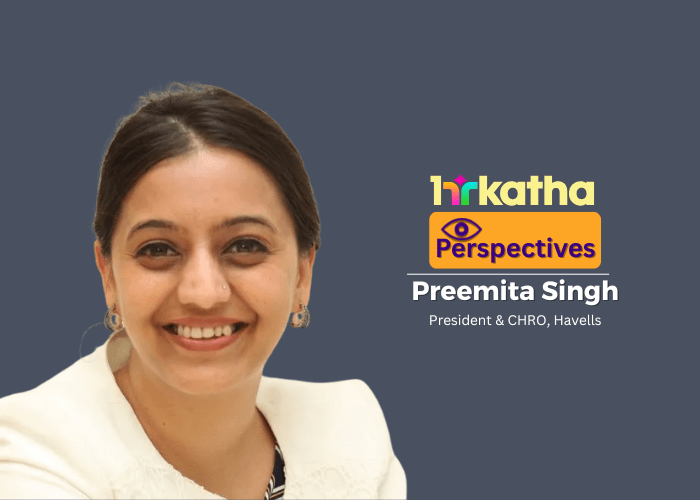
Consumer companies have long mastered the art of understanding customers—their preferences, pain points, moments of delight and frustration. However, when it comes to employee experience, there is far less intentionality. The same organisations that obsess over customer journey mapping frequently treat employee touchpoints as transactional administrative processes rather than designed experiences.
Preemita Singh, president and CHRO, Havells India, challenges this inconsistency. Under her leadership, Havells approaches employee experience with the same rigour as customer journey design—intentional, inclusive and value-driven. In conversation, she articulates why future-ready talent requires contextual intelligence over static skills; why inclusion must move from awareness to accountability; and why the next-generation CHRO will be part strategist, part technologist and part behavioural scientist.
Contextual intelligence over credentials
Are you hiring for skills that exist today or capabilities to learn what doesn’t exist yet? What does future-ready talent mean at Havells?
At Havells, ‘future-ready’ refers to curiosity, adaptability and contextual intelligence. We don’t just hire for what exists today; we hire people who can learn, unlearn and reinvent themselves in new situations. Our hiring process is conversational and values-based, focusing on entrepreneurial spirit, empathy and creative energy. Candidates are encouraged to assess us as much as we assess them. We look for people who connect purpose with performance, who have the agility to grow with evolving technologies and markets.
We believe in building talent from within. We have developed interventions such as Sankalp, Prateek and Step Up to build leadership and capability across levels. We are taking steps to promote internal mobility systematically and are making investments in talent development across the board. At Havells, adaptability and learning agility are the real future skills.
“The next-gen CHRO will be part strategist, part technologist, part behavioural scientist.”
Flexibility with accountability
Three years into hybrid work, what’s your conviction about the future of workplace design?
What we’ve learned is that where work happens is less important than how people feel connected to purpose. Our goal is to enable flexibility with accountability. Productivity, collaboration and culture-building can coexist when people feel trusted and clear about outcomes.
“HR isn’t a siloed function; it’s a business engine that shapes capability, culture and growth.”
Employee experience as designed journey
How rigorously do you design employee experiences—from first interview to last day—with the same intentionality you apply to customer journeys?
At Havells, we approach employee experience with the same rigour as customer journey design—intentional, inclusive and value-driven. Every interaction, from the first interview to the last day, is shaped by six pillars: workforce planning, culture anchored in values, talent development, process excellence, inclusion and distributed leadership.
Our engagement platforms—such as Yours Havells and Srishti—foster storytelling and recognition, whilst wellness initiatives such as Wellness Wednesday and the Care Leave Pool Programme reinforce a culture of care and solidarity. Learning platforms such as e-Gurukul make growth self-driven, and recognition systems celebrate impact over hierarchy. Leadership connects through Town Halls, Dil Se sessions and Talent Talks to ensure transparency and mentorship.
These efforts have earned us Great Place to Work certification for six consecutive years, validating trust and pride across our workforce. Our next opportunity lies in ensuring consistency across geographies and roles, so every employee experiences belonging and possibility in a diverse, multi-generational workplace.
“Inclusion doesn’t mature with awareness—it matures when leaders become accountable.”
From awareness to accountability
How do you train managers and interviewers to recognise and counteract biases? What changes have you made to promotion and hiring processes to level the playing field?
We’ve moved from awareness to accountability. Inclusion at Havells is built into leadership behaviour, not policy statements. Managers are trained to listen, challenge assumptions and recognise performance rooted in authenticity. Structured panels, bias-awareness sessions and clear evaluation frameworks ensure fairness.
We are also proud to see steady improvement in gender representation, as our women’s workforce share continues to rise, alongside stronger inclusion across functions. The focus is on potential, not pedigree. Performance and initiative define advancement here, regardless of background or seniority.
“Employee experience must be designed with the same rigour we apply to customer journeys.”
HR as business function, not silo
For young HR professionals aspiring to work in consumer goods, what’s misunderstood about HR in this industry? What skills differentiate a great HR leader from someone who’s just competent?
Let me start with something industry-agnostic: the biggest misunderstanding about HR—whether in consumer goods or elsewhere—is that it’s viewed as a support function rather than a business function. Even in evolved organisations, HR gets seen through a purely functional lens: policies, processes, compliance. What goes missing is the business context. HR is central to serving the customer, acts as a franchise point for the organisation, and helps companies absorb shocks and mitigate risks.
Now, specifically in consumer goods, this becomes even more critical. HR in this sector is about shaping growth at scale, enabling capability across diverse geographies and preserving the human ethos in high-volume, fast-moving operations. Great HR leaders don’t just manage processes—they create ecosystems where people thrive. They understand business context deeply, connect empathy with execution and lead with purpose.
The differentiator isn’t just expertise; it’s ownership, agility and the ability to translate culture into competitive advantage. In consumer goods, where brand perception, customer experience and operational excellence are interlinked, HR must operate as a strategic business partner—not a siloed function.
“Flexibility works only when trust is non-negotiable and accountability is shared.”
The next-generation CHRO
If someone is entering HR today and wants to be a CHRO in 15 years, what should they be learning that isn’t in traditional HR curricula?
There’s an old saying: if your cup is full, where will you fill it? That mindset—constant unlearning and relearning—is what defines the next generation of CHROs.
The future CHRO will be part strategist, part technologist and part behavioural scientist. You need data and digital fluency, but also deep understanding of human behaviour and motivation. Design thinking, storytelling and business acumen are crucial because they teach you to see systems and people together. Neuroscience helps you understand how people actually learn and change.
Above all, cultivate learning agility—the ability to absorb, adapt and contextualise quickly. That’s what will keep you relevant in a world where every skill has an expiry date.
“Future-ready talent isn’t about today’s skills—it’s about the curiosity to learn what doesn’t exist yet.”
The unwritten rule
What’s one unwritten rule at Havells that you wish more people understood earlier in their careers?
The most important unwritten rule at Havells is to step up and own it. Those who take initiative, collaborate across boundaries and drive ideas forward grow fastest. Leadership here is not about hierarchy; it is about contribution. If you have an idea and the energy to execute it, you will find support.
Ownership, collaboration and the courage to lead are what move careers forward. Influence here is earned through impact, not position.
1 Comment
An organization where half a dozen CHRO changed in the last 15-20 years, where Leadership positions are mostly hired from outside without internal elevation of the employees, when the attrition rate are higer than market standard, then such comments are good to read or listen in the pod cast only.