



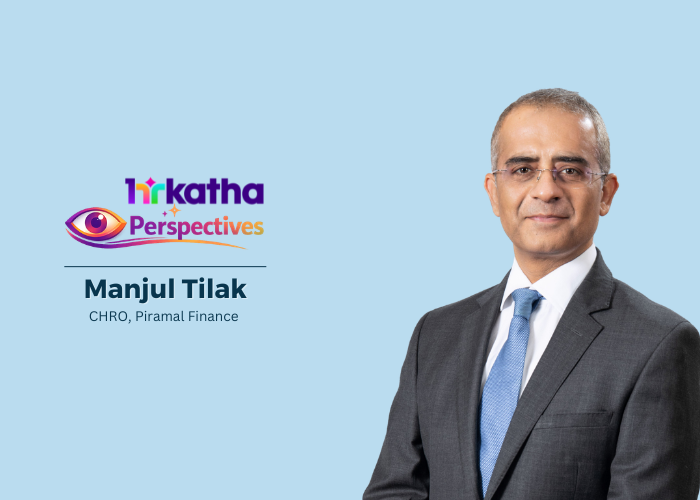
Piramal Finance is a young NBFC with ambitions that do not behave like one. It has scaled rapidly across sales, underwriting, collections, credit and digital functions, with a distributed workforce that spans everything from branch operations in tier-two towns to data science teams building the models that increasingly shape lending decisions. In a sector where regulatory discipline and technological disruption are accelerating simultaneously, the HR challenge is no longer simply about hiring and retention. It is about building a workforce capable of operating at the intersection of both.
Manjul Tilak leads that effort as CHRO. In conversation with HRKatha, he explains why AI adoption fails when it remains confined to technology teams, why the most meaningful HR credibility metric is growth outpacing headcount, and why curiosity matters more than credentials in a business being rebuilt in real time.

Every role touches technology now
What changes when the business itself becomes technology-led, and what does future-ready talent mean in that environment?
In financial services today, no single technical skill stays relevant for long. What has changed is that employees are no longer operating inside static systems. They are working alongside systems that continuously evolve through automation, analytics and AI-driven decision-making.
At Piramal Finance, AI and data-led workflows are already embedded across sales, underwriting, audit, compliance, collections and people management. Every role interacts with technology in some form, regardless of function or seniority. That is not a future aspiration. It is the current operating reality.
Which means hiring can no longer focus only on domain expertise. We increasingly look for adaptability, curiosity and the ability to learn continuously alongside technology. We value people who are comfortable operating in ambiguity, who ask questions about how systems work, and who see technology as something to work with rather than something happening to them.
Internally, we try to build that mindset through initiatives like Build Your Own Dashboard and Build Your Own Technology, where employees solve real business problems using analytics and digital tools. The principle behind both is simple: innovation cannot remain confined to technology teams. The most meaningful ideas often come from people closest to the work.
Every role interacts with technology now, regardless of function or seniority.”

260 hires, no human intervention
How do you make employees experience AI as an enabler rather than a threat?
AI adoption works when employees experience it as something that makes them more effective rather than more replaceable. At Piramal Finance, our AI strategy – piramal.ai – is already embedded across underwriting, collections, customer experience, audit, compliance and recruitment.
One example illustrates the scale of that integration. In a single quarter, more than 260 frontline candidates were hired through an AI-led workflow. Screening, shortlisting, interview scheduling, assessment and decision sequencing were automated end-to-end. That is not a pilot. It is part of how the organisation now operates.
But the lesson we drew from this was not that AI capability should sit inside a small specialist group. In fact, the opposite is true. AI cannot become the domain of a few specialists. The strongest use cases emerge from employees who interact directly with customers and understand how work actually happens on the ground.
That is why democratising adoption matters. The real implementation challenge is not building models. It is making AI tangible and useful for frontline teams rather than limiting it to technology or analytics functions.
The resistance we encounter is rarely opposition to AI itself. It is usually rooted in unfamiliarity and fear of redundancy. Both reduce when employees see AI improving everyday work in visible ways, and when organisations are honest about which human capabilities remain irreplaceable: judgement, ethics, empathy and leadership.
“AI cannot become the domain of a few specialists. The strongest use cases come from people closest to the work.”
Innovation inside governance
How do you prevent governance from suffocating innovation, without allowing innovation to weaken governance?
This is one of the defining leadership tensions inside financial services. Lending businesses are naturally designed around control because the cost of getting decisions wrong is immediate and measurable, through NPAs, regulatory scrutiny and customer harm. But fast-growing NBFCs also need experimentation, speed and the willingness to challenge existing models.
Both instincts are necessary. The objective is not to choose one over the other. It is to build a culture capable of holding both simultaneously.
At Piramal Finance, we try to make those boundaries explicit. Experimentation is encouraged and failure is tolerated. But governance discipline and customer responsibility are non-negotiable.
Senior leaders reinforce that balance behaviourally, not rhetorically – challenging legacy processes in one meeting and insisting on compliance rigour in the next. The consistency of that leadership behaviour matters more than any formal communication.
What keeps the balance productive rather than paralysing is shared purpose. When teams understand that governance and innovation are ultimately serving the same objective – building a sustainable business and serving customers responsibly – the tension becomes easier to navigate. Younger employees especially respond to that clarity. They want to understand what the organisation believes, not simply what it permits.
“The job is not to choose between governance and innovation. It is to design a culture that holds both simultaneously.”
Growth outpacing headcount
What actually earns HR credibility with business leaders in a fast-scaling NBFC?
HR earns credibility when it understands the business as deeply as it understands people. In a rapidly scaling financial services business, that means being able to speak meaningfully about productivity, growth, technology adoption and operational efficiency, and not only about engagement or attrition metrics.
The metric I return to most often is this: over the past two years, business growth at Piramal Finance has significantly outpaced growth in operational headcount. Automation, digital workflows and AI-led systems have made that possible. When HR can demonstrate a direct connection between people decisions and commercial outcomes, the conversation with business leaders changes fundamentally.
But credibility is not built through dashboards alone. It is built through judgement and execution. The business leader sitting across from you is not thinking about the HR calendar.
They are thinking about capability gaps, productivity friction, customer outcomes or organisational bottlenecks slowing growth. HR has to enter those conversations on business terms with enough commercial understanding to diagnose what is actually happening beneath the surface and the influence to act on it across functions that do not report into HR directly.
“The business leader sitting across from you is not thinking about the HR calendar.”
Build breadth before depth
What should young HR professionals deliberately seek if they want to lead HR in financial services over the next decade?
The CHRO role in financial services will look very different over the next decade. It will become more deeply integrated with AI strategy, productivity transformation and business reinvention. The HR leaders who are prepared for that shift will be the ones who build commercial breadth early rather than deepening HR expertise alone.
My advice is simple: spend time on the frontline.
Understand what a collections conversation actually feels like. Observe how a credit decision gets made when the model gives you one answer but the customer sitting across the table suggests another. Understand what drives sales behaviour under pressure and where operational bottlenecks emerge in practice rather than on process maps.
That understanding of how the business creates value, and where it breaks down, is what separates HR leaders who influence commercial decisions from those who simply support them.
Beyond that, become genuinely comfortable with data and AI not as a spectator but as a practitioner. Learn enough design thinking to apply it to workforce problems. And develop the ability to influence without authority, because the most consequential HR work happens across functions rather than within HR itself.
The leaders who will matter in this sector are those who can combine technology fluency, business understanding and human judgement.
Technology fluency without judgement creates risk. Business understanding without people insight creates rigidity. Human judgement without commercial understanding creates irrelevance.
“The leaders who will matter are those who can combine technology fluency, business understanding and human judgement.”