


For employees working across branches and field roles, the organisation can often feel less like an institution and more like the person they report to every day. That gives the immediate manager enormous influence over performance, engagement and, ultimately, whether people stay.
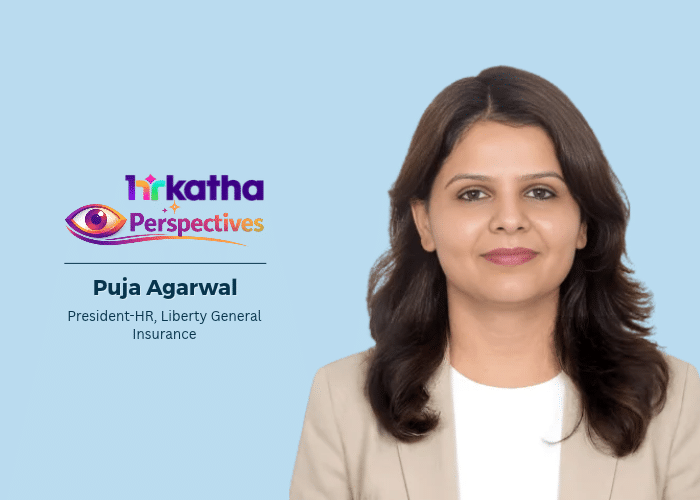
At Liberty General Insurance, Puja Agarwal argues that this changes how manager performance itself should be judged. Strong numbers cannot be viewed in isolation from the people producing them. In conversation with HRKatha, the president-HR explains why sustainable performance must include team stability, why exit interviews capture the end of the attrition story rather than its beginning, and why HR’s contribution to the business has to be visible in talent productivity and customer outcomes.
The manager as the organisation
Can someone be a successful manager if the numbers are strong but good people keep leaving the team?
For many employees, particularly those in branches or field roles, the manager is the organisation. They shape how employees understand expectations, experience the workplace and form their view of whether this is somewhere they want to build a career.
That makes manager quality one of the most consequential variables in the entire people system.
We assess manager effectiveness through a combination of business results and people outcomes, and the two have to be held together rather than treated as separate scorecards.
Team stability, regrettable attrition, quality of hiring, internal movements, employee feedback and development conversations are all part of the picture.
A manager who consistently delivers numbers while losing people cannot be considered to be delivering sustainable performance. The numbers are real, but they are not the whole story, and they are rarely sustainable.
We invest significantly in manager development, particularly around the transition into management. People often become managers without fully understanding how the accountability shifts when they take on that role.
Structured onboarding into management, practical toolkits, mentoring and specific capability around feedback, recognition, performance conversations and conflict resolution are all part of how we try to close that gap.
In a dispersed organisation, consistency of leadership approach matters more than in a centralised one. A branch manager in a remote location has to be equipped to make good people decisions largely on their own.
That requires more investment in manager capability, not less.
“Talent productivity is the first measure I would take to the board: are we building the workforce capacity to grow the business and serve customers?”
What exit interviews miss
If compensation is often only the visible explanation for attrition, where should organisations look for the signals that appear before someone decides to leave?
People do not always leave because of compensation. They leave when they do not see a future in the organisation, do not feel supported by their manager or feel that the effort required to succeed is not recognised.
In frontline and sales roles especially, the quality of the daily work experience matters as much as the package. Target pressures, clarity of expectations, customer challenges, travel, the technology available and manager behaviour all shape retention in ways that compensation alone cannot address.
Exit interviews often capture the immediate trigger for someone leaving rather than the accumulated experience that led to that decision. By the time someone is sitting in an exit interview, the question of why they are leaving has usually been settled for weeks or months.
The real signal was somewhere earlier.
That is why we look at retention through multiple lenses: tenure cohorts, manager patterns, performance indicators and early warning signals such as absenteeism, declining productivity and reduced participation. The key is identifying those patterns before they crystallise into a resignation.
That is only possible when you remain genuinely connected to employees rather than relying on formal processes to surface what is actually happening.
We also see the reverse clearly. Employees who stay for many years tend to have had trusted managers, felt supported by the organisation, seen visible career possibilities and experienced a genuine sense of belonging.
Those factors are harder to engineer than a compensation adjustment, which is precisely why they are more durable as retention levers.
“The discipline is in being honest about which situation you are actually in rather than defaulting to whichever approach feels more comfortable.”
Build, buy and the balance between them
Organisations often talk about balancing internal development with external hiring. Why is putting a fixed ratio on that balance potentially misleading?
There is no fixed ratio between building internally and hiring externally, and I would be suspicious of any organisation that claimed to have one. The right balance depends entirely on what the organisation needs at a specific point in time.
Leaders who grow within the organisation understand the culture, customers, distribution realities and operating context in ways that take external hires much longer to acquire. That institutional fluency has real commercial value, particularly in general insurance where relationships and local market understanding matter.
At the same time, external talent brings perspectives and capabilities that an organisation cannot always develop from within, and there are moments when that is exactly what is needed.
Our investment in the internal pipeline is continuous: structured development programmes, differentiated career experiences, mentoring and deliberate exposure to strategic business problems. We want future leaders to be strong on the fundamentals, digitally fluent and genuinely customer-centric.
But we hire externally when a capability does not exist internally or when the organisation needs a different way of thinking about a problem. Both are legitimate answers to different questions.
The discipline is in being honest about which situation you are actually in rather than defaulting to whichever approach feels more comfortable or more cost-effective in the moment.
“A manager who consistently delivers numbers while losing people cannot be considered to be delivering sustainable performance.”
Learning that connects to real work
What separates learning that actually changes capability from learning that merely gets completed?
Learning becomes part of culture when it is connected to real work. When training is treated as a separate activity that needs to be completed, employees experience it as exactly that: an obligation rather than an investment in their development.
In a fast-moving environment such as general insurance, where regulations, products and technology are constantly changing, formal programmes alone cannot carry the learning agenda.
Employees need opportunities to learn through work experiences, customer situations, peer exchanges, stretch assignments and regular feedback from managers who model continuous development themselves.
The shift we are trying to make is from a training-completion mindset to a capability-application mindset. Completion is an input. The more important question is whether employees can actually apply what they have learnt in the situations they face.
When training is application-based and managers reinforce the desired behaviours in real time, outcomes follow. When neither of those conditions is met, the hours are logged but nothing much changes.
The biggest structural challenge is accountability. Business pressure makes learning feel optional, and it will continue to feel optional until it is integrated into business plans, performance conversations and career progression rather than managed as a standalone HR topic.
“Exit interviews capture the immediate trigger for leaving, not the accumulated experience that led to the decision.”
What the board needs to see
If the board gave you room for only three measures of the people agenda, which ones would tell it the most about the health of the business?
The first is talent productivity and capacity: are we building the capability and workforce depth required to grow the business, serve customers and execute the strategy?
This is the most direct connection between the people agenda and commercial performance, and it is the question board members are actually asking when they ask about HR.
The second is the quality of talent decisions: regrettable attrition, internal fill rates for critical roles, succession readiness and the stability and quality of new hires. These tell you whether the organisation is building capability deliberately or simply reacting to vacancies.
Internal fill rates for critical roles in particular tell a board more about organisational health than engagement scores alone.
The third is customer and business outcomes linked to people capability: sales quality, customer satisfaction, claims productivity and how manager effectiveness and employee capability contribute to those outcomes.
It is not enough to report business outcomes in isolation. The board needs to understand what role the people system played in producing them.
Those three taken together move HR from reporting activity to demonstrating impact, which is the conversation the function needs to be having at board level.
“The balance between building internally and hiring externally cannot be fixed at any ratio. It depends entirely on what the organisation needs at that point.”