



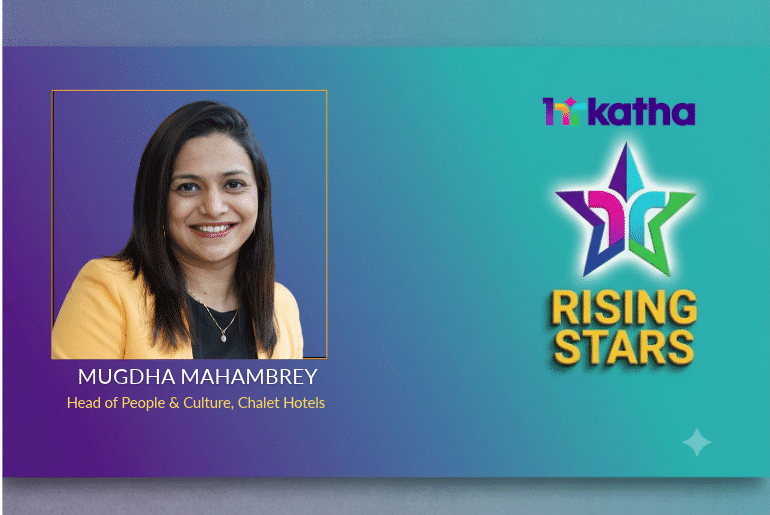
Mugdha Mahambrey wants to run a hotel as its CEO someday. For someone who has built a career in human resources, the ambition may appear unconventional. For Mahambrey, however, it is a logical progression of what she has spent much of her professional life arguing: that HR is a business function.
If HR leaders are expected to understand operations, productivity, growth and commercial performance, why should their leadership potential remain confined to their own function?
Mahambrey, head of people & culture at Chalet Hotels, sees the movement between HR and business leadership as an opportunity to challenge some of the assumptions organisations continue to make about both.
The business question first
One of the biggest challenges of Mahambrey’s career has been getting organisations to recognise HR as a business function rather than simply a support function.
Her approach begins with a business question: what is the organisation trying to achieve, and what does it need from its people, structures and culture to get there?
Starting there changes the nature of the conversation. Instead of beginning with policies, programmes and processes, HR begins with productivity, capability, growth and organisational performance.
But commercial relevance brings its own risks.
“In becoming commercially relevant, HR cannot lose its heart,” she says.
Mahambrey believes the function must remain conscious of the people affected by business decisions. Understanding commercial priorities does not mean accepting that every decision should be judged exclusively by its financial consequences.
Balancing those considerations, she acknowledges, is something she expects to continue working on throughout her career.
What changed for the business?
Mahambrey evaluates HR initiatives through a deceptively simple question: what changed for the business because of what HR did?
Participation numbers and engagement scores can provide useful information, but she is more interested in whether an intervention has improved productivity, strengthened retention, developed capability, reduced risk or created an internal leadership pipeline.
In hospitality, talent development provides a particularly tangible test. Are management trainees progressing into leadership positions? Are critical hotel roles being filled internally? Are employees who received coaching taking on greater responsibilities?
For Mahambrey, some of the most meaningful evidence comes from seeing management trainees she has worked with become hotel leaders and members of her own teams progress into director of HR roles at prominent hotels.
The same emphasis on outcomes extends to restructuring and productivity initiatives. Completing an organisational redesign is not, in itself, a measure of success. Sustainable cost savings and operational continuity are among the outcomes she looks for.
Her preferred assessment brings together two forms of evidence: the human story and the business number.
“If I can demonstrate both, I know the initiative has created real impact,” she says.
Leadership should travel both ways
What particularly excites Mahambrey is the movement of leaders between HR and business roles.
She points to the Indian Hotels Company (IHCL), where Gaurav Pokhariyal moved from HR into a chief operating officer role, while Prabhat Verma moved from operations into the chief people officer role.
For her, such appointments challenge the conventional separation between people management and business leadership.
“We have spent years saying HR needs to understand the business. But I think the reverse is equally true: business leaders need to deeply understand people,” she says.
The argument is especially relevant in hospitality, where the quality of employee performance has a direct bearing on the experience customers receive. Decisions about staffing, capability, leadership and culture are difficult to separate from decisions about the business itself.
Mahambrey wants her own career to demonstrate that connection. She hopes eventually to move from influencing a business through its people function to accepting responsibility for its overall performance.
“If we truly believe HR is a business function, then an HR leader should be able to move beyond the function and eventually run the enterprise. I would love my own career to demonstrate that possibility.”
Developing people as a leadership legacy
Mahambrey’s most satisfying professional memories are not necessarily associated with the largest programmes she has introduced.
They involve people whose careers she has helped develop: management trainees who became hotel leaders, colleagues who progressed into larger HR roles and general managers whose professional journeys she helped shape.
That instinct extends beyond the workplace. She has also encouraged the children of people who work in her home to pursue education and career opportunities.
What interests her is the possibility of recognising potential in someone before that person has necessarily recognised it themselves.
“Your own career is one journey. But if, along the way, you can positively alter the trajectory of several other people’s journeys, that becomes your real legacy.”
For Mahambrey, developing others is therefore both an organisational responsibility and a personal measure of leadership.
AI with accountability
Mahambrey approaches AI through practical applications rather than the pressure to adopt technology simply because it is available.
Her team is exploring an AI-enabled policy assistant that could give employees quicker access to answers about routine workplace matters. It has also examined the possibility of reusable AI agents for policy and employee queries.
In recruitment, the team is testing applications involving job descriptions, candidate screening and the summarisation of interview feedback, while retaining human responsibility for final decisions. Privacy and governance remain important considerations, particularly when AI is used to assess or shortlist CVs.
Mahambrey also sees opportunities in workforce analytics, including the examination of salary costs, workforce expenditure and patterns that may inform business decisions.
The objective is to improve the speed and quality of analysis without confusing technological capability with decision-making authority.
“AI can provide speed, analysis and insight but accountability, context, empathy and judgement must remain human,” she says.
Confidentiality without secrecy
Working closely with both business leaders and employees requires HR to manage information that cannot always be shared openly.
Mahambrey distinguishes transparency from unrestricted disclosure. She believes HR should be truthful about what can be communicated and equally honest about what cannot.
Wherever possible, she explains the context and reasoning behind decisions. Where confidentiality prevents a fuller explanation, she makes that limitation clear rather than offering misleading reassurance.
“Trust is built when people know two things about you: that you won’t misuse what they tell you in confidence, and that you won’t mislead them when you cannot tell them the whole story,” she says.
It is a principle that becomes increasingly important as HR gains access to more employee information through technology and analytics.
Switching off is part of sustaining performance
Hospitality can demand periods of considerable intensity, but Mahambrey does not believe that intensity should become a permanent expectation.
She uses physical activity to recharge and encourages opportunities for employees to connect outside their usual professional routines through offsites, games and initiatives such as 100 Days of Running.
Such activities can provide a welcome break, although sustained wellbeing also depends on how organisations manage everyday workloads and expectations.
Mahambrey encourages employees to take their leave and disconnect from work without guilt.
“I don’t believe exhaustion is a badge of commitment,” she says.
Her position is consistent with her broader leadership philosophy. Commercial performance matters, but organisations must remain attentive to the conditions under which people are expected to deliver it.
Quick Takes
Conflict style: Mediation. Resolve, don’t escalate.
Engagement driver: Recognition. People remember being genuinely valued.
Feedback preference: Instant. Don’t save today’s conversation for tomorrow’s review.
Retention tool: Career growth. Compensation attracts; opportunity retains.
Team energy booster: Brainstorming, preferably over coffee.
An ambition beyond the corporate world: To become the chief minister of Goa someday. She has always been drawn to opportunities that allow her to influence outcomes and make a difference in people’s lives.
Why she is a Rising Star
Mahambrey challenges the assumption that commercial leadership and people leadership belong to separate professional tracks. Her emphasis on measuring HR through both business outcomes and employee progression gives that argument practical substance. Equally telling is her ambition to run a hotel, accepting broader accountability rather than simply advocating HR’s strategic relevance. Her career reflects a belief that understanding people should be a qualification for business leadership, not a reason to remain confined to one function.
Rising Stars is HRKatha’s editorial series profiling the next generation of HR leaders shaping the future of the profession. The series features winners and finalists of the HRKatha Rising Star Leadership Awards alongside emerging professionals whose work, ideas and leadership potential deserve wider recognition.
