


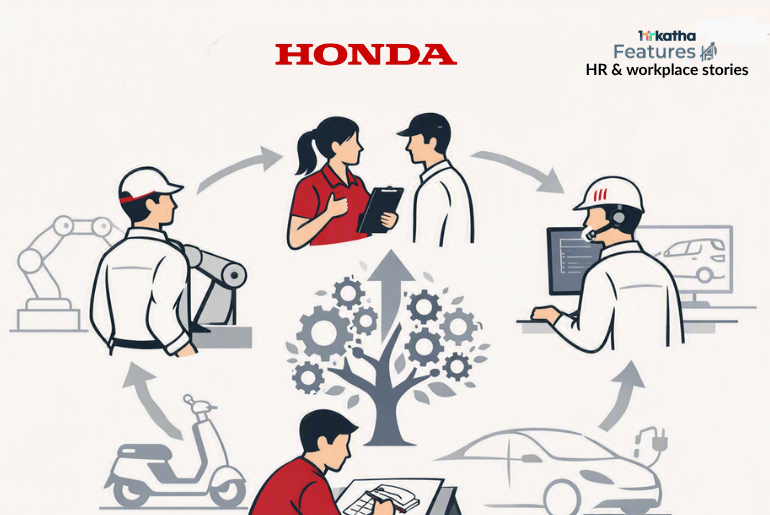
Retention is usually the problem. At Honda Motorcycle and Scooter India (HMSI), it is not. Nearly 60 per cent of its employees have been with the company for more than a decade. Around 70 per cent have more than five years. The pipeline is deep, the institutional knowledge substantial, and the succession model largely internal.
The harder question is what to do with all that loyalty.
“Manufacturing is changing, technology is changing, the expectations are changing, everything is changing, but the people remain the same throughout,” says Vinay Dhingra, senior director of HR and admin, IT, CSR & corporate affairs, Honda Motorcycle and Scooter India. People still want recognition, growth and the chance to pursue ambitions. What has changed is the number of alternatives available to them outside the organisation, and therefore the pressure on HMSI to keep adapting to what they need inside it.
“Manufacturing is changing, technology is changing, the expectations are changing, everything is changing, but the people remain the same throughout.” says
Vinay Dhingra, senior director-HR & admin, IT, CSR & corporate affairs, HMSI

That is a different problem from the one most manufacturers describe. HMSI is not struggling to attract talent or worried about mass attrition. It is working out how to stop a long-tenured workforce from becoming comfortable rather than capable.
Movement as the antidote to comfort
HMSI’s internal approach requires employees to move into new roles every three to five years, with commercial roles rotating roughly every three years. The company rarely hires directly into senior positions; it builds towards them. Japanese coordinators rotate across functions every three years, introducing perspectives from other Honda operations globally without making external hiring the primary source of fresh thinking.
The model has clear logic. Deep institutional knowledge compounds when people move across functions rather than staying within them. A manufacturing specialist who has spent three years in sales understands customer context in ways that improve how they think about production. Cross-functional mobility creates a more integrated organisation.
The friction, however, is real. A function receiving an internal candidate often prefers an experienced external hire for the specific role. Dhingra acknowledges this as an area where mobility still needs work. Stating that internal movement is the default is not the same as making it structurally easy. The gap between policy and practice in cross-functional mobility is one of the more persistent problems in large manufacturing organisations, and HMSI has not fully resolved it.
The risk of long tenure compounding into comfort rather than capability is something Dhingra names directly. “Pushing people out of their comfort zone” is one of his stated HR challenges for the coming years. The Centre of Excellence for Learning and Development, created over the past two years, is the primary vehicle for addressing it. Employees, including senior leaders, are expected to have four- to five-year learning plans that combine business requirements with individual aspirations.
The diversity gap is partly a geography problem
HMSI wants women to make up 30 per cent of its workforce by 2030, up from around 12 per cent today. The ambition is significant, but the company is not starting from scratch. A visit to its plant floor shows women working alongside men across manufacturing operations, while the company has also made changes to the way its plants operate to make these roles more accessible.
The company has also recently established an entirely women-run paint shop line at its Vithalapur plant. This line is currently operating with women employees in two of its three shifts, but represents a more direct attempt to create an operating environment that supports greater participation of women in manufacturing.
The challenge, as Dhingra points out, is scaling this representation. Plant and technical roles remain the hardest areas in which to attract women, and a diversity target by itself cannot address all the factors that influence those hiring decisions. Manufacturing facilities are often located outside urban centres. For a woman weighing two comparable job offers, travelling 40 kilometres to a plant when another opportunity is available within the city can be a practical consideration rather than a cultural preference.
HMSI is also competing for a talent pool that has changed considerably. Engineering graduates who may once have viewed manufacturing as a natural career choice now have a much wider range of options, particularly across technology and digital businesses. The competition, therefore, is not simply for more women in manufacturing, but for engineering talent in a labour market where manufacturing is no longer the only obvious destination.
There is also a clear business imperative. Around 30 to 40 per cent of Honda’s two-wheeler customers are women, making greater representation within the workforce relevant not only from an inclusion perspective but also to how the company understands and serves its customer base.
“The biggest change so far has been mindset, although challenges remain,” Dhingra says. For HMSI, the next phase may be about turning that shift in mindset into changes in the way manufacturing careers are designed, accessed and sustained for women.
When the manager is the culture
Honda’s “Respect for the Individual” is a founding principle that appears in policy documents and leadership communications. Whether it reaches the shop floor depends almost entirely on the person an employee reports to.
“HR can explain the philosophy and establish policies,” Dhingra says, “but an employee experiences the organisation primarily through the person they report to.”
HMSI uses several mechanisms to close that gap. My Voice, a direct feedback platform, allows employees including blue-collar associates to raise ideas and concerns with directors. Critically, the platform crosses functional boundaries. A manufacturing employee can raise a point relevant to sales and have it reach the sales director. Hundreds of ideas are received monthly, according to Dhingra.
Gemba, the practice of going directly to the workplace to understand what is happening, supplements formal channels. Town halls and open-office design, including common cafeterias across levels and the absence of executive cabins, are intended to reduce visible hierarchy.
The logic is sound. Organisations with strong values but hierarchical structures often find that the values survive only in parts of the organisation where senior leaders happen to be present. Structural design that reduces status signalling makes it harder for hierarchical behaviour to coexist with stated principles.
Performance first, engagement second
Dhingra is blunt about the limits of conventional engagement.
Events and activities can create energy, he says, but real motivation eventually comes down to performance, growth and appraisal. An employee who does not receive a promotion or a meaningful increment is unlikely to place much value on other engagement interventions.
HMSI supplements its appraisal system with recognition routes that sit outside it. Kaizen, the continuous improvement platform, rewards implemented ideas through graded monetary recognition, with exceptional contributions reaching company-level evaluation and the possibility of an overseas visit to another Honda plant. Honda Circle of Dreams brings small teams together to work on business challenges over one to three months, with strong projects recognised at national level.
These platforms do something a conventional engagement calendar cannot: they let employees influence the work itself. That distinction matters. Social activities and cultural events address the surface. Platforms that connect contribution to recognition address something more durable.
Safety before production, and the AI question
In manufacturing, well-being begins with safety. At HMSI, safety is the first item in weekly and monthly business reviews. If a production target is missed because an unsafe condition required work to stop, employees are not questioned for the decision.
That is not a universal norm in manufacturing. Stating it as policy and enforcing it as practice are different things. The fact that Dhingra describes it as a settled principle rather than an aspiration suggests it has genuinely reached operational level, though independent verification is not possible from outside.
The technology question is more complicated. Around 90 per cent of Honda’s workforce is in manufacturing, where roles are broken into specific tasks, with a typical operation lasting roughly 20 seconds. Most machine-related positions can be learnt within a month. AI, in that context, is less immediately transformative to production roles than it is to sales, customer management and supply functions, where HMSI has begun scaling AI application this year.
Electric vehicles represent a larger skilling challenge. Dedicated EV and AI programmes are being planned across roles, with deeper specialist capability required in design and model development.
The Gen Z adjustment runs both ways
Younger employees at HMSI arrive with stronger foundational skills and more choices than earlier generations. They may also arrive without a clear understanding of manufacturing culture, including practices such as Saturday working.
Dhingra resists the framing that this makes them difficult to manage. The task, he says, is to understand them and guide them. That requires leaders who are willing to examine their own assumptions alongside those of the people they are managing.
HMSI has expanded its life-stage policies in recognition that the employment proposition cannot remain static as employee expectations evolve. Interest-free two-wheeler loans cover up to 95 per cent of the ex-showroom price. A home-loan subsidy covers 50 per cent of the interest on eligible amounts. Quarterly flight tickets for employees transferred between locations whose families cannot relocate were introduced two years ago. Sabbatical provisions cover higher education, illness and specified family circumstances.
These are not headline-grabbing benefits. They are practical responses to real life-stage pressures that affect whether a manufacturing career remains viable for people building families and managing other responsibilities.
The test ahead
HMSI is managing several tensions simultaneously: experience against experimentation, internal development against the value of outside perspective, manufacturing discipline against newer workforce expectations, and a historically male workforce against a more representative future one.
Its underlying proposition has remained consistent over many years: give people a reason to stay, a reason to learn, a voice and room to grow. The question now is whether that proposition, designed for a world of steady-state manufacturing, is agile enough for one being reshaped by electrification, AI and a generation that has more options than any before it.
Long tenure is an asset. It only remains one if the experience behind it keeps moving.