


Insurance is peculiar. Unlike technology companies that sell innovation or consumer goods firms that sell aspiration, insurance companies sell promises—commitments to be present during life’s most vulnerable moments. Competitive differentiation comes almost entirely from how people experience the organisation, not what it produces.
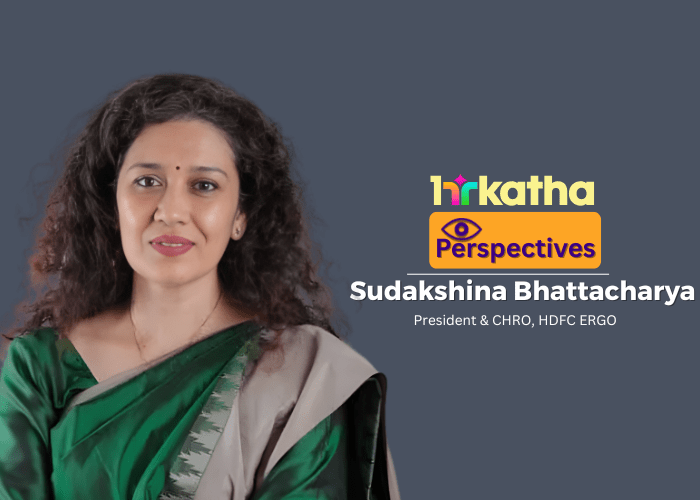
Sudakshina Bhattacharya, President & CHRO at HDFC ERGO, operates within these realities daily. In conversation, she articulates why managing five generations represents abundance rather than complexity, why data without context accelerates bad decisions, and why the real work of HR leadership is replacing “but” with “yes-and”.
The gift of generational abundance
Can one culture truly serve five generations simultaneously, or are we moving towards personalised employee experiences?
I honestly think this is the most exciting time for any organisation because Gen Z has given us a language that sharpens our North Star. When they talk about purpose, sustainability, flexibility, being seen and heard… these are not new ideas. Organisations have always done these things, but earlier they were so natural that they didn’t require articulation.
Baby boomers and Gen X also worked for meaning; they simply didn’t feel the need to define it. But Gen Z has its own language. If they want to frame the organisation’s reason for existence as purpose—fine. This is their natural acclimatisation.
Managing five generations isn’t a challenge – it’s abundance. Abundance of perspectives, dimensions, and lived experiences.
At HDFC ERGO, our Gen Z retention is above industry benchmarks – and that’s not by accident. We’ve always had an open culture: Express, employee assistance programmes, sharing circles. Earlier, people gravitated naturally. Now Gen Z says, “Great, but show me where to go, show me how to access it.” They want structure around what has always existed. And when they feel heard, it amplifies everything we do.
For me, a multi-generational workforce is a gift. It’s not about one-size-fits-all or hyper-personalisation—it’s about creating meaning in moments that matter and letting every generation find its own rhythm within a shared purpose.
For me, a multi-generational workforce is a gift.
“If Monday mornings excite people, HR has already won”
The litmus test: real growth opportunity
How do you ensure purpose, values and social impact are real and not just marketing slogans?
HDFC ERGO’s Foundation Day rests on the core value of People First. Our philosophy of #GrowTogether comes alive through initiatives that go beyond boundaries. LoveAll, our DEI movement, promotes inclusion, and PlayAble makes diversity and inclusion engaging through interactive formats. Through Purpose Beyond Boundaries, employees have contributed thousands of volunteering hours, creating a real social impact.
At HDFC ERGO, we start with something simple: every employee is first a human being. That’s our “Human Code”. Before the grade, band or function—you are a human being walking into the organisation every day. So our question is: How do we hold space for you?
Traditionally, we invested in leadership programmes only after a certain level. But Gen Z made us invert the pyramid. Because we’re geographically dispersed across over 820 pin codes, talent is scattered far from headquarters visibility. By the time these colleagues come into organisational line of sight, it’s already been a decade. We realised they want growth now, not after 12 years.
So we created a leadership programme specifically for the junior-most cadre, in partnership with IIM Calcutta. What would have taken 12 or 13 years now takes two and a half. We selected 25 out of approximately 3,000 applicants. Even though only 25 were chosen, it gave hope to 7,000 frontline colleagues.
That’s the litmus test. When people feel they can build a career here, purpose becomes lived experience—not a slogan.
“Employee experience is the product—everything else in insurance can be copied”
Data plus context equals insight
Is HR actually making better decisions with analytics and AI, or just making biased decisions faster?
HDFC ERGO adopted data-based decision-making several years ago. We changed our performance appraisal model after data showed the six-point scale wasn’t working. Data showed that at a certain band, people hit fatigue because of long vintage requirements—three years before moving up. That’s where we were losing our best talent. So we redesigned the growth strategy for that specific cohort.
What has shifted is that people no longer rely on data alone—they rely on insights. What is the data telling me? What relevance does it have in context?
We use Amber, our AI-driven listening tool. I get a daily dashboard—what’s the organisation’s mood? Who’s hit a work anniversary? Which cohorts need intervention? From there we create focus-group conversations—because data tells you one thing, but voices tell you the story beneath the numbers.
Even policies such as post-maternity softer landing came from insights. Some women want to return full throttle; others need gradual re-entry. The policy isn’t blanket—it’s customised per individual.
Data plus context plus insight is what truly drives meaningful talent decisions.
“Merit becomes visible only when the environment allows diverse voices to be heard”
Build environments, not targets
How do you balance genuine meritocracy with acknowledging that merit is often defined by the dominant group?
Our strategy has evolved significantly. Initially, we focused on building gender balance. Today, we focus on building inclusion—because if the environment is inclusive, all forms of diversity flourish naturally.
Our inclusion philosophy is inspired by nature: nothing grows at the cost of something else. Our template is literally a long-shot of a jungle—trees, bushes, mangroves thriving together.
When leaders see the business impact of diverse voices—gender, geography, abilities, socio-economic background—the narrative shifts. From “Oh, we have to hire women” to “That idea that transformed the business came from her—how do we reward her?” Merit becomes visible in new ways.
Inclusion is not theoretical. We have our entire employee base certified in Indian Sign Language. Why? Because if I meet someone who communicates differently, I should be able to greet them. Inclusion starts with equipping ourselves.
Instead of pushing diversity mandates, we asked: “Are we creating enough space for meaningful contribution to shine?”
“If employees can see a future, purpose stops being a slogan and becomes lived experience”
Thriving, not surviving
How do you know when diverse hires are thriving and not just surviving?
Let me give you a real example. A few years ago, in our enthusiasm to hire colleagues with visual impairment, we brought in several people—only to discover we lacked the technological support they needed. It was devastating. We simply weren’t equipped.
We paused, fixed our tools, rebuilt the support system, and only then restarted hiring. The second cohort thrived. One visually impaired colleague used his/her experience here as a launchpad—he/she prepared for administrative services, cleared it and moved on. We feel proud to have played a small part in his journey.
The real indicator: Can they thrive? Not just survive.
Infrastructure is not just ramps and washrooms. Inclusion is in the details. If a woman is in advanced pregnancy, can she get the closest parking spot? If someone has locomotive challenges, can we ensure their parking doesn’t require struggle?
If we get the details right, we create an environment where everyone thrives.
“Inclusion works only when environments are ready—good intent is never enough”
HR in insurance: people as differentiator
For young HR professionals, what’s misunderstood about HR in your industry?
This industry offers tremendous opportunity because it’s entirely people-intensive. Nothing else differentiates us—products can be copied, processes can be replicated. People are the real differentiator.
My only advice: Don’t add colour to your work. Strategy, operations, advisory—whatever it is, work is work. Approach it simply. Do it well. Over time you’ll look back and see how beautiful a portfolio you’ve built.
“A multi-generational workforce is not complexity. It is abundance”
The metrics that matter
If you had to defend HR’s value using only three metrics that truly matter to the CEO and the board, what would they be?
In today’s world, HR doesn’t need to defend its value anymore. The function’s evolution has placed HR squarely beside the CEO. Still, there are indicators that matter.
First: How many people genuinely look forward to coming to work on a Monday morning? There’s no metric more honest. It reflects culture, meaning, purpose, leadership—everything an organisation claims to stand for.
Second: The organisation’s daily “mood-o-metre”. Not everyone responds every day, but observing this trend over a few days reveals more than any quarterly report.
Third: Employee Net Promoter Score. If employees are proactively promoting the organisation, it signals trust, pride and a strong psychological contract.
“Culture isn’t an enabler in insurance—it is the competitive differentiation”
The yes-and pursuit
Every CHRO faces impossible trade-offs—speed versus inclusivity, consistency versus flexibility, cost versus quality. What’s the trade-off that keeps you up at night?
What keeps me up at night is the constant effort to replace “but” with “yes-and”.
Instead of cost versus quality, if it can be cost and quality. Instead of attrition versus productivity, retention and productivity. Instead of expense optimisation versus customer value, optimisation and value. The real struggle is to stop seeing trade-offs as opposing ends and start treating them as collaborators in a broader system.
At HDFC ERGO, we focus on sustainable, profitable growth. In insurance, top-line growth can be misleading unless it translates into healthy bottom-line results. Sustainable, profitable growth expands the decision-making frame, forcing leaders to think beyond this quarter. It’s not about today’s profit at the cost of the next three years—it’s about expanding the table so multiple priorities can coexist.
My relentless pursuit: How many “either-or” choices can be turned into “yes-and” possibilities? That’s the real work of modern HR leadership—balancing multiple truths without compromising on any.
“Replace ‘but’ with ‘yes-and’—that’s the real work of HR”