



Demergers create a distinctive HR challenge. The new organisation inherits employees shaped by a different culture, operating in a context that no longer exists. Leaders must build identity, trust and engagement simultaneously, often without the institutional memory or established systems of the parent company.
When Sanofi Consumer Healthcare India became a standalone organisation, Roma Bindroo, people director, resisted the instinct to begin with values workshops or culture campaigns. Instead, the company started with a simpler exercise: asking employees what was working, what was not, and then redesigning the organisation accordingly.

“As a healthcare organisation, what we create for our customers and stakeholders is what we also give to our employees.”
Roma Bindroo, people director-India, Sanofi Consumer Healthcare India

The answers were practical rather than philosophical. Compensation ranges no longer matched FMCG benchmarks. Leaders and HR teams felt distant. Employees wanted greater visibility into what was happening beyond their immediate roles. Career opportunities appeared limited.
“We started with actually asking questions with teams to say, ‘What do you think we are doing well? What do you think we are missing out on?’” Bindroo says.
Each theme became an action plan. Compensation was benchmarked against FMCG peers. Leadership visibility increased. Communication mechanisms were redesigned. The underlying logic was straightforward. Before expecting employees to adapt to a new organisation, the organisation first needed to adapt to its employees.
There is no average employee
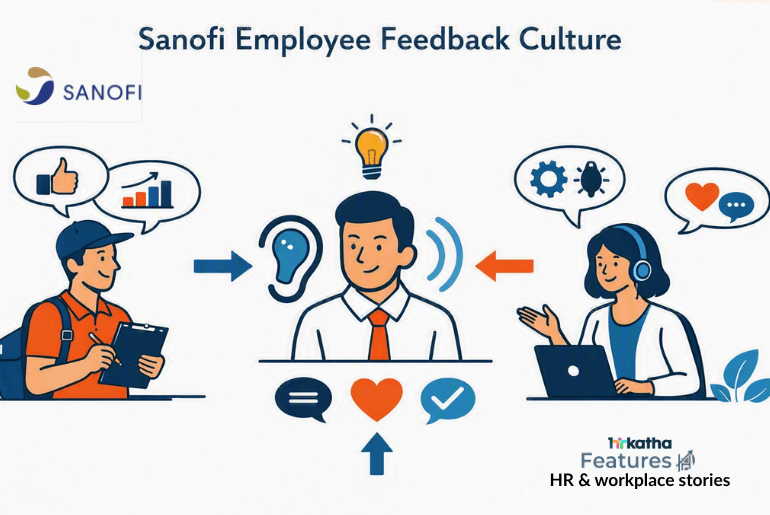
Sanofi Consumer Healthcare India consists of three distinct workforces: commercial field teams, a technology centre and a corporate office. Each works differently, faces different constraints and expects different things from the organisation.
“When we build a people-first culture, it cannot be a standard that works for everybody,” Bindroo says.
Instead of imposing one engagement model, the company built different listening mechanisms for each group. Sales teams elect employee representatives who meet leadership regularly. The GCC operates a culture committee that gathers feedback each month and communicates actions transparently.
The approach reflects an important reality that many organisations overlook. Culture initiatives are often designed for an imagined average employee who rarely exists. The more diverse the workforce becomes, the less useful one-size-fits-all interventions tend to be.
Whether this responsiveness remains as the organisation grows will become the more difficult test. Listening mechanisms often become slower and more procedural as organisations mature.
When listening changes operations
Several operating indicators moved in the same direction after the feedback-led changes.
Hiring time reduced from around 120 days to approximately 45 days. Employee referrals now account for between 25 and 30 per cent of recruitment. Internal mobility increased as employees began moving across functions and into broader roles. Individual development plans achieved around 70 per cent completion soon after launch, with the company targeting 90 per cent.
“Thirty per cent of my hiring is happening through referrals,” Bindroo says.
Referral rates are among the more useful cultural indicators available to HR leaders. Employees recommending former colleagues or friends effectively place their own professional credibility behind the organisation.
The company also reports strong retention and consistently positive engagement scores during its first two years as an independent organisation.
None of these measures proves causation on its own. Together, however, they suggest that the company’s emphasis on listening translated into operational improvements rather than remaining an engagement exercise.
Purpose begins inside
Bindroo believes the company’s external purpose should also shape employee experience.
“As a healthcare organisation, what we create for our customers and stakeholders is what we also give to our employees,” she says.
That philosophy influences decisions around medical insurance, flexibility and workplace design. Employees are often quickest to notice when organisations promote wellbeing externally while neglecting it internally.
She also observes that changing workforce demographics require organisations to remain adaptable.
“With millennials and Gen Z entering the workforce, every generation brings its own culture and values.”
Beyond the Pride post
“Everybody’s putting a Pride post,” Bindroo says. “That’s no more a moment of pride. What is a moment of pride is how do we ensure inclusion is built in everything we do?”
That observation captures how the company’s approach to inclusion has evolved.
Rather than relying primarily on awareness campaigns, Sanofi Consumer Healthcare India invited openly LGBTQIA+ leaders from organisations such as Godrej and Microsoft to share their experiences with employees. It also partnered with external networks to widen access to LGBTQIA+ talent.
The conversation has since expanded beyond gender to include people with disabilities, cognitive diversity and broader workplace inclusion.
Whether these initiatives ultimately reshape representation across hiring and leadership remains to be seen. The more significant shift is that inclusion is increasingly being treated as an operating principle rather than an annual campaign.
Embedding culture into systems
Perhaps the company’s most significant structural decision has been integrating culture into its talent processes.
Its challenger mindset behaviours, including “All In Together” and “Courageous”, now influence hiring, development planning, leadership assessments and recognition programmes.
“All our awards are in line with those behaviours,” Bindroo says.
That integration matters because culture survives when it becomes part of recruitment, development, promotion and recognition. It fades when it exists only in presentations and posters.
The listening challenge
Bindroo believes the next challenge extends beyond her own organisation.
“Workplaces are in real danger of losing connection on ground,” she says.
As organisations become larger, flatter and increasingly hybrid, relationships risk becoming transactional.
“Forget about best friend,” she says. “Do people have a friend at work?”
Sanofi Consumer Healthcare India’s culture journey began with a simple decision: ask before prescribing.
That approach helped the company build its people strategy around employee experience rather than leadership assumptions.
The larger challenge now is one faced by every organisation that grows after a demerger.
Listening is relatively easy when the organisation is small. Preserving that responsiveness as layers, processes and distance accumulate is considerably harder.
Culture rarely fails because organisations stop talking. It usually fails because they stop listening.