



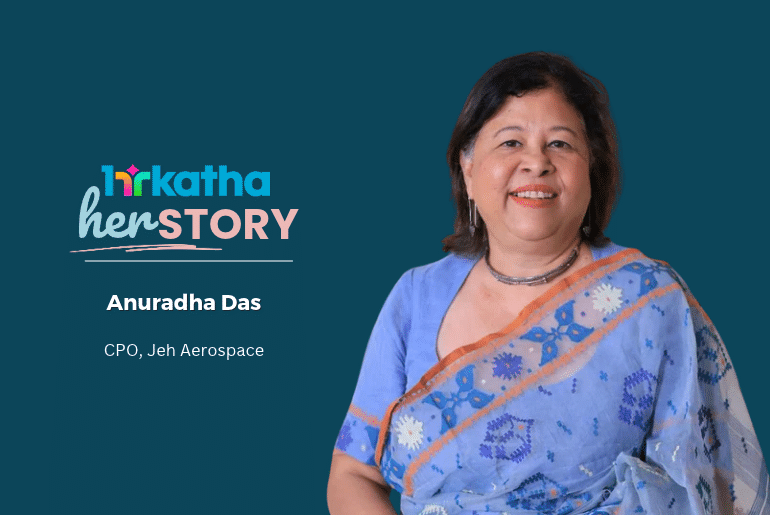
Delivering with precision
For Anuradha Das, chief people officer at Jeh Aerospace, the people function must hold itself to the same standards as the manufacturing shopfloor.
In aerospace, quality standards audit people’s competence as rigorously as they audit the product. Das believes HR delivery must follow the same principles: First Time Right and Zero Defects.
No employee is released onto a critical operation until certified. Pay, compliance, training records and certifications must be accurate every time. Every new entrant follows a defined path to full proficiency, with timelines that are tracked.
“Empathy is how we deliver this, not an excuse for missing the standard,” says Das. “We’re empathetic in how we coach people and uncompromising on the standard they must reach. Mistakes are allowed while people are learning, never in what we deliver.”
Her emphasis on precision does not mean she expects everyone to think or work alike. Across functions, generations and cultures, she believes alignment comes from shared purpose. When an operator on the shopfloor and an engineer in design can both see how their work contributes to the aircraft and reaches the customer, alignment follows.
That requires simple policies, visible goals and frequent conversations in which leaders listen as much as they speak.
“Mistakes are allowed while people are learning, never in what we deliver.”
The courage to return
Given a choice between a candidate with exceptional technical expertise and one with extraordinary learning agility, Das would choose the latter, provided the candidate possesses the technical fundamentals.
Expertise indicates what someone can do today. Learning agility, she believes, indicates what they will be able to do five years from now, when aircraft, materials and tools may have changed.
Her own career offers some explanation for that preference.
Das returned to work after a break of more than a decade, teaching herself what she had missed during those years. She was out of work, but never out of business. The experience reinforced her belief that a curious mind will catch up, while a closed one eventually falls behind.
Returning to work was the first major professional risk she identifies in her career. The second was leaving large, established organisations to build the people function at an aerospace start-up from scratch.
Both experiences taught her something she now shares with younger professionals: “Your age or your career gap doesn’t define you. Your willingness to learn and take charge does.”
Making room for women
When Das became the first woman plant HR head at Tata Motors, women were still an unusual presence on the manufacturing shopfloor.
Later, as chief diversity officer, she encountered scepticism over the proposal to establish an all-women assembly line. There were doubts about whether enough women would be willing to work on the shopfloor and whether they would stay.
Das and her team began with a pilot, involving production leaders in redesigning the line. Workstations and tools were adapted for ergonomics, partnerships were established for earn-and-learn programmes, and arrangements were made for safe transport and housing.
The team shared quality and output data openly. Once the line delivered, it no longer needed defending.
While manufacturing has changed considerably since then, Das believes three areas still require attention: workplaces designed for everyone from the outset, visible women role models in technical leadership and recruitment from ITIs and colleges that consciously includes women from day one.
She has encountered gender bias herself, mostly in its quieter forms: being the only woman in the room or having to prove a point twice.
She learnt to let results speak, find allies and ensure that the next woman would not have to prove herself twice.
Quick fire round
Call sign?
Tailwind: we’re there to help everyone fly faster and further.
Cockpit or control tower?
Both. HR must fly the plane with the business, and sit in the control tower too, seeing the whole airspace and helping everyone land safely.
Best quality for turbulence?
Decisiveness, held steady by resilience.
One future skill every engineer should learn?
Working fluently with data and AI, and explaining that work in plain language.
Mantra for difficult days?
Aviate, navigate, communicate. That’s the pilot’s rule in a crisis: keep the plane flying, find a way to make a safe landing, and communicate only when it is necessary.
Building leaders like aerospace components
Das draws a parallel between developing leadership talent and manufacturing a component that must perform reliably under pressure.
One starts with the right material, which in leadership means values and character. Stretch assignments, rotations and feedback provide the shaping. Challenging experiences allow potential leaders to be tested before they take on critical responsibilities.
There must also be honest assessment and sufficient redundancy, which in organisational terms means building bench strength for every critical role.
The difference, she notes, is that a component is finished when it leaves the production line. A leader continues to develop.
At Jeh Aerospace, another test of her leadership came when the organisation introduced Excellerate, moving towards flatter, band-based structures with performance-linked rewards tied to each employee’s date of joining.
Securing acceptance was not easy. The rationale was explained in person, team by team, alongside the growth opportunities available through rotations, cross-skilling and shared prosperity through Sammriddhi and ESOPs.
For Das, it was the clarity of those conversations, more than anything else, that earned acceptance.
“Your age or your career gap doesn’t define you. Your willingness to learn and take charge does.”
Seek the difficult assignment
“Go to the shopfloor. Credibility in manufacturing is earned where the work happens,” is Das’ advice to young women aspiring to lead in advanced manufacturing and engineering.
She encourages them to understand the technology, even when their own roles are not technical, and to seek opportunities that take them beyond familiar responsibilities.
“Ask for the difficult assignment,” she suggests, because that is where visibility comes from.
Her advice also draws on her experience of returning to work after a prolonged career break. If life calls for a pause, she believes women should take it without guilt, while continuing to learn so that they can return stronger.
She encourages them to find sponsors and, when they rise, hold the door open for others.