


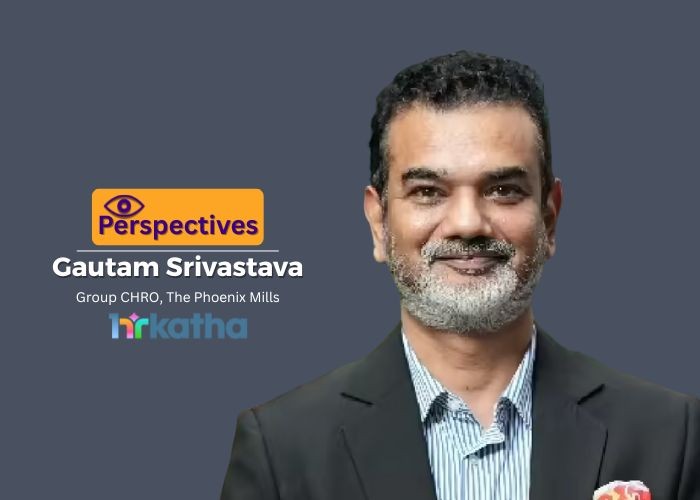
Retail and hospitality operate on thin margins where employee experience directly translates to customer experience. A disengaged sales associate, an unmotivated service staff member, or a conflict between shift workers becomes immediately visible to customers. This creates unique imperatives for human resources—culture cannot be an abstraction discussed in town halls; it must be practiced moment by moment on the shop floor.
Gautam Srivastava, Group CHRO, The Phoenix Mills, manages a five-generation workforce where stability meets adaptability, patience encounters digital-first thinking, and traditional hierarchy coexists with collaborative work practices. In conversation, he articulates why generational diversity represents strategic advantage rather than complexity, why learning cultures require embedding curiosity into daily work rather than offering programmes, and why mobility adds breadth whilst purpose determines when to stay.
Five generations as strategic advantage
Can a single organisational culture genuinely serve baby boomers and Gen Z simultaneously, or is fragmentation inevitable?
At Phoenix Mills, we see our five-generation workforce as a strategic advantage rather than a complexity to manage. Each generation brings its own strengths—from the wisdom, patience and institutional knowledge of our senior talent to the agility, innovation and digital-first mindset of our younger workforce. Together, they create a powerful blend of stability and adaptability.
We consciously nurture this diversity through mutual learning—via reverse mentoring, flexible work practices and cross-generational collaboration. Our shared purpose of “creating destinations that inspire” serves as the glue that binds us. The idea isn’t to impose uniformity but to craft one cohesive culture that embraces multiple experiences. Our core values remain constant, but how we live and express them evolves with every generation. That’s how inclusion and belonging move from policy to practice.
“In retail and hospitality, HR is not transactional—it’s deeply strategic and experience-driven.”
Curiosity as daily practice
How do you create a culture where continuous learning is embedded in daily work, where failure is seen as feedback, and where curiosity is rewarded?
There’s a difference between having learning programmes and being a learning organisation. At Phoenix Mills, we believe that learning isn’t an event—it’s a habit. A true learning culture takes root when curiosity becomes part of everyday conversations, not just a line item in a training calendar. We focus on experiential learning—embedding learning opportunities in real projects, business challenges and cross-functional collaborations.
The blockers are often structural: rigid hierarchies that discourage questioning, performance systems that penalise mistakes, and leadership behaviours that reward compliance over curiosity. Breaking these requires intentional design—creating safe spaces for experimentation, celebrating intelligent failures and recognising those who ask powerful questions, not just those who have ready answers.
“It’s not about coding; it’s about connecting human behaviour, technology and business value.”
HR in retail and hospitality
For young HR professionals who aspire to work in your sector, what’s misunderstood about HR in this industry? What skills or experiences genuinely differentiate a great HR leader from someone who’s just competent?
HR in our sector is often perceived as purely transactional—focused on hiring, compliance or policy execution. In reality, it’s deeply strategic and experience-driven. Our workforce operates across retail, hospitality and destination management—sectors that demand agility, empathy and business acumen in equal measure.
Great HR leaders in this space understand the business intimately. They know what drives customer experience, what influences commercial outcomes, and how people decisions ripple through operations. The differentiator is the ability to connect people insights with business realities. The most successful HR professionals here don’t just manage processes—they design experiences that shape brand perception and employee engagement simultaneously.
“Don’t become a collector of experiences without depth—stay long enough to see your decisions play out.”
The skills of tomorrow
If someone is entering HR today and wants to be a CHRO in 15 years, what should they be learning that isn’t in traditional HR curriculums?
The HR leaders of tomorrow will need to balance human empathy with digital fluency. Whilst traditional HR foundations like labour laws and organisational design remain relevant, the future belongs to those who understand AI, data storytelling and design principles.
They’ll need to think like product managers—designing employee journeys, using analytics to anticipate behaviour, and solving problems through experimentation. It’s not so much about coding as it is about connecting dots between human behaviour, technology and business value. Future CHROs must be able to translate insights into strategy and strategy into action—that’s the real strategic value.
“Future-ready CHROs won’t just design policies—they’ll design employee journeys.”
When to move, when to stay
For HR professionals early in their careers, what’s your advice on career mobility—should they move companies every 2-3 years for faster growth, or stay longer to see the impact of their work?
Early career professionals often equate growth with movement—but moving too fast can make you a collector of experiences without depth. True development happens when you stay long enough to see your decisions play out, whether through business transformation, a crisis or a cultural shift.
Mobility certainly adds breadth, but purpose matters more. Move when there’s learning, stagnation or misalignment with values. Stay when growth is happening, impact is visible, and the organisation invests in your future. The worst mistake is staying out of comfort or moving out of restlessness. Be intentional—understand what each chapter teaches you, and choose accordingly.
1 Comment
Insightful read!
Gautam Srivastava nails it — the CHRO of the future must think like a product manager: design better employee journeys, use data to understand people, and continuously iterate to build trust across generations. HR is no longer about processes; it’s about creating experiences that make organisations future-ready.