

Close Menu
    Facebook X (Twitter) Instagram
    • Our Story
    • Partner with us
    • Reach Us
    • Career
    Subscribe Newsletter
    HR KathaHR Katha
    • Exclusive
      • Exclusive Features
      • Perspectives
      • Friday Features
      • herSTORY
      • Rising Stars
      • Case-In-Point
      • Point Of View
      • Research
      • HR Pops
      • Dialogue
      • Movement
      • Profile
      • Beyond Work
      • By Invitation
    • Brief News
      • Global HR News
      • Compensation & Benefits
      • Diversity
      • Events
      • Gen Y
      • Hiring & Firing
      • HR & Labour Laws
      • Learning & Development
      • Merger & Acquisition
      • Performance Management & Productivity
      • Talent Management
      • Tools & Technology
      • Work-Life Balance
    • Special
      • Editorial
      • HR Forecast 2026
      • Cover Story
      • HR Forecast 2024
      • HR Forecast 2023
      • HR Forecast 2022
      • HR Forecast 2021
      • HR Forecast 2020
      • HR Forecast 2019
      • New Age Learning
      • Coaching and Training
      • Learn-Engage-Transform
    • Studio
      • The CHRO Playbook
      • Quick HR Insights
      • The Corner Office
    • Reports
      • Whitepaper
        • HR Forecast 2024 e-mag
        • Future-proofing Manufacturing Through Digital Transformation
        • Employee Healthcare & Wellness Benefits: A Guide for Indian MSMEs
        • Build a Future Ready Organisation For The Road Ahead
        • Employee Experience Strategy
        • HRKatha 2019 Forecast
        • Decoding and Driving Employee Engagement
        • One Platform, Infinite Possibilities
      • Survey Reports
        • Happiness at Work
        • Upskilling for Jobs of the Future
        • The Labour Code 2020
    • Forums
      • HRKatha Inner Circle
      • HRKatha Futurecast
      • Leadership Summit 2025
      • Rising Star Leadership Awards
      • HRKatha Futurecast 2025
      • Automation.NXT
      • The Great HR Debate
    WhatsApp LinkedIn X (Twitter) Facebook Instagram
    HR KathaHR Katha
    Home»People»Movement»Employees using AI may face lower managerial trust: Study
    Movement

    Employees using AI may face lower managerial trust: Study

    The findings showed that employees who completed the task independently received supervisors' trust 68 per cent of the time
    HRK News BureauBy HRK News BureauNovember 6, 20263 Mins Read183 Views
    Share LinkedIn Twitter Facebook WhatsApp
    Share
    LinkedIn Twitter Facebook WhatsApp

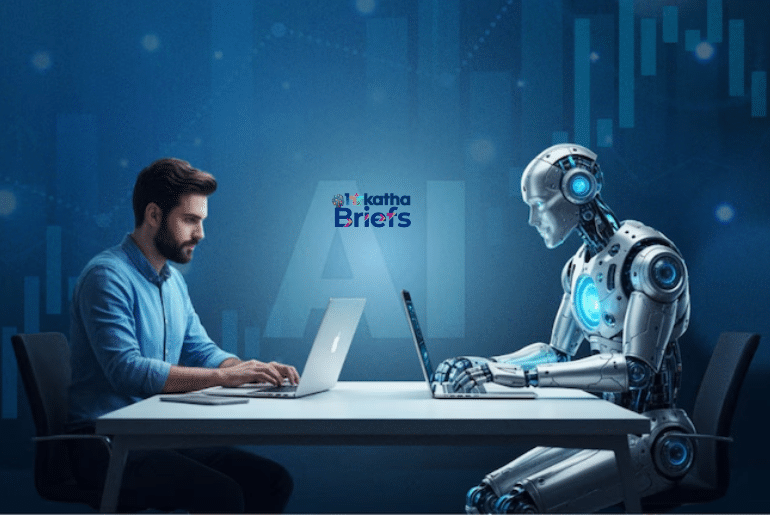
    Employees who use artificial intelligence tools such as ChatGPT at work may be viewed as less trustworthy by their supervisors, potentially affecting performance assessments and career progression, according to a six-study research paper published in _The Leadership Quarterly_.

    The researchers conducted five incentivised economic experiments and one field study involving academic supervisors to examine how employees’ use of large language models (LLMs) influences managerial trust.

    In one experiment, supervisors were asked whether they would accept an employee’s account of the time taken to complete a task or independently verify the information. The findings showed that employees who completed the task independently received supervisors’ trust 68 per cent of the time. When employees used AI-generated output, the likelihood fell to 24 per cent.

    AI-assisted work, however, was viewed more favourably than work copied from another person.
    The researchers noted that the experiment focused on supervisors’ willingness to trust employees’ accounts rather than the quality of the final output. This suggests that the knowledge of AI involvement itself influenced perceptions of employee trustworthiness.
    The consequences extended beyond immediate trust.

    Across the studies, lower supervisory trust was associated with poorer perceived performance, lower assessments of organisational citizenship behaviour and reduced perceptions of employees’ promotability.

    The research also found that organisational policies played a significant role in shaping supervisors’ reactions. When companies explicitly encouraged employees to use LLMs, the negative effect on supervisory trust was no longer statistically significant.

    However, the trust penalty remained when organisations prohibited AI use or had no clearly stated policy on its adoption.

    The researchers also examined whether task importance or supervisors’ own experience with AI influenced their responses. Neither consistently reduced the negative effect.

    A field study involving academic supervisors evaluating graduate students’ work produced similar findings. The broader the students’ use of LLMs, the lower the supervisors’ reported trust in them.

    The findings raise questions for employers that are encouraging AI adoption while leaving employees uncertain about how its use will affect their professional standing.

    Employees may feel compelled to conceal their use of AI tools if they believe admitting to it could damage their credibility or career prospects. This can contribute to what is commonly described as ‘shadow AI’, where workers use AI tools without formally disclosing that they are doing so.

    For organisations, the findings suggest that introducing AI tools alone may not be sufficient. Clear guidelines on acceptable use, alongside consistent communication with managers, could help employees understand when and how AI-assisted work is appropriate.

    The study does not establish that every employee using ChatGPT will face lower trust or reduced promotion prospects. Instead, it highlights how managerial perceptions of AI use can influence workplace evaluations, and how explicit organisational support can change those perceptions.

    AI AI at work Culture diversity Employee Employee Benefits Employee Engagement employees employer Employment Engagement HR Human Resources Productivity Recruitment Training Workforce Workplace
    Share. LinkedIn Twitter Facebook WhatsApp
    HRK News Bureau

    Leave A Reply Cancel Reply

    Related Posts

    UP approves 30-day Diwali bonus for government employees

    November 6, 2026

    The HR question that has no perfect answer

    November 6, 2026

    Meta to cut one-third of France workforce through voluntary buyouts?

    November 6, 2026

    US hiring holds steady, but opps for Indian job seekers may remain limited

    November 6, 2026
    zoha
    Editorial

    Hard work built India’s global reputation. Availability cannot define its future

    I must have been in school when I first heard the slogan. I was passing…

    The rift between the corner office and the floor below

    A general manager at a large Indian steel conglomerate recently described an exchange with his…

    EDITOR'S PICKS

    The HR question that has no perfect answer

    November 6, 2026

    herSTORY: Nandini Matiyani, GCHRO, Strides

    November 5, 2026

    Case-in-Point: The internal whistleblower bypass

    November 5, 2026

    HR Perspectives by Dev Jha: “Engagement scores are not the same as commitment”

    November 4, 2026
    Latest Post

    UP approves 30-day Diwali bonus for government employees

    Brief News November 6, 2026

    The Uttar Pradesh government has approved a 30-day bonus for eligible state-government employees for the…

    Employees using AI may face lower managerial trust: Study

    Movement November 6, 2026

    Employees who use artificial intelligence tools such as ChatGPT at work may be viewed as…

    The HR question that has no perfect answer

    Friday Features November 6, 2026

    There are questions at work that HR can answer cleanly. And then there are the…

    Rising Star: Ineet Bagga on why the real advantage lies in how quickly an organisation can unlearn

    Rising Stars November 6, 2026

    Ineet Bagga believes organisations need to become better at letting go of practices that no…

    Asia's No.1 HR Platform

    Facebook X (Twitter) Instagram LinkedIn WhatsApp Bluesky
    • Our Story
    • Partner with us
    • Career
    • Reach Us
    • Exclusive Features
    • Cover Story
    • Editorial
    • Dive into the Future of Work: Download HRForecast 2024 Now!
    © 2026 HRKatha.com
    • Disclaimer
    • Refunds & Cancellation Policy
    • Terms of Service

    Type above and press Enter to search. Press Esc to cancel.