


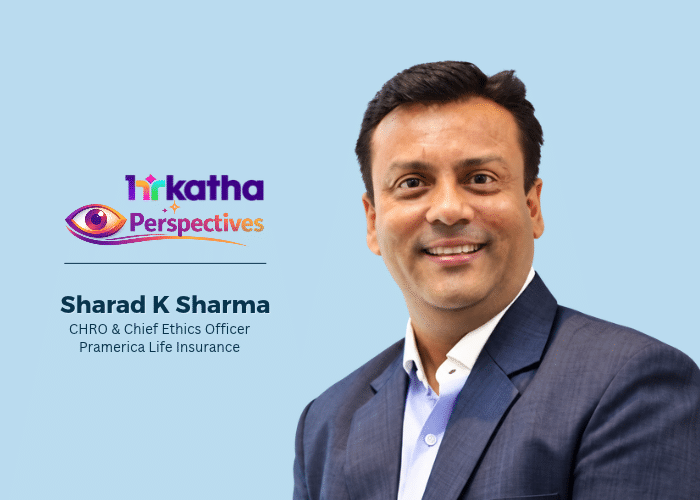
Pramerica Life Insurance operates in a sector where the frontline workforce is large, geographically dispersed and under constant sales pressure. Attrition is a structural feature of the industry rather than an anomaly. The more useful question for HR, therefore, is not simply why people leave, but when the conditions that eventually lead to an exit first begin to emerge.
Sharad K. Sharma has been working on that question as CHRO & Chief Ethics Officer. In conversation with HRKatha, he explains why the first 90 days matter disproportionately in frontline retention, why every significant people decision at Pramerica is expected to have a framework and logic behind it, and why training is better judged through business quality, fraud reduction and manager effectiveness than through hours completed.
The first 90 days
If compensation is not always the reason people leave insurance sales, what happens in the first 90 days that determines whether someone is likely to stay?
Attrition is attributed to compensation most of the time, but it is not always about compensation.
For us, frontline sales accounts for around 80 per cent of the employee base. One pattern we have observed is that when attrition happens within the first 90 days, it is driven by a few specific factors.
The first is fit. Many people join without prior exposure to insurance and assume they will be able to manage the role. Insurance selling is tough, and it can ultimately become a question of fit with the organisation.
The second is the manager. If the manager does not have adequate people-management capability, the new employee is not handled well and leaves.
The third is early success. People who experience success in their first 90 days are significantly more likely to stay than those who do not.
That is why our biggest area of focus in managing early attrition has been ensuring that people can taste success quickly. We have restructured induction to explain earning potential and career opportunities clearly. Training is organised around specific cohorts, zero to four months and five to eight months, so interventions are relevant rather than generic.
We have also moved well beyond exit interviews. In a distributed setup with more than 130 offices, the challenge is ensuring that people are actually heard. We run regular pulse surveys, town halls immediately after board meetings, skip-level sessions and sessions I conduct myself where I randomly select employees and simply speak with them.
In a distributed organisation, what you hear from people in the field can be very different from what surveys surface. So we create more in-person opportunities rather than fewer.
We also analyse attrition by manager, location and geography. When attrition concentrates somewhere, we ask whether it is a geographical issue, a manager issue or an engagement issue. That analysis drives how we adjust incentives, training and career programmes in specific pockets.
“Culture is the first metric I would take to the board. Are you improving it year on year?”
Build, buy and develop deliberately
When does developing someone internally make more sense than hiring capability from outside, and how do you decide between the two?
It is a combination of build and buy, and the discipline lies in being clear about which situation calls for which approach.
We hire management trainees from premier colleges through a programme called SOAR, put them through six to nine months of training and develop them for future leadership roles.
Over the last three years, we have brought in roughly 17 to 18 management and executive trainees across business and enabling functions. This cohort is specifically brought in to challenge conventional ways of working and represents one deliberate layer of our future leadership pipeline.
The second route is internal sales leadership development. In our producing channels, particularly our defence channel, we have a structured career-advancement programme through which people move from frontline roles into supervisory positions. We have people who joined as sales managers and are now leading regions and zones as senior leaders within the channel.
The third area is new-age capabilities such as actuarial, risk, technology and AI, where the skills may simply not exist internally. Here, we hire from outside.
Underlying all of this is our talent review plan. Every year, we meet all middle managers and above for a structured review that combines 360-degree feedback, self-assessment and the manager’s assessment.
We classify people into three categories: ready for expansion of responsibility, needs to consolidate in the current role, or a concern requiring close monitoring. Those identified as ready for expansion are the people we actively give broader responsibilities to.
That process is how the internal pipeline is built rather than assumed.
“The branch manager is the lynchpin. If they do the right things, they will have a well-performing team.”
Frameworks over gut feeling
People decisions inevitably involve judgement. Where does a framework improve that judgement, and where have you seen data challenge what a manager instinctively wanted to do?
One principle we follow is that every people decision has to be based on a framework and some form of logic. We try to keep emotion out of the process.
When it comes to people decisions, managers can become emotional. Their recommendations can be heavily influenced by personal relationships and contain less data to support the case. Whether it is a career-progression decision, a long-term incentive, an exception to a stated policy or selecting someone for broader responsibility, we have frameworks that assign scores and apply predetermined thresholds.
This applies to learning programmes too. Our leadership coaching programme has a framework. It is not something everyone automatically qualifies for. We evaluate ratings over the last three years, key contributions, 360-degree feedback, talent assessment by the immediate manager and cross-functional feedback. We then create a score and take decisions based on a defined threshold.
When we redesigned our work-from-home policy, we did not change it based on what managers felt. We analysed productivity data and benchmarked the market, then built a framework around how flexibility should be structured.
When we design incentive schemes, we back them with data on market practices and build models around who qualifies, how much ratings contribute and how feedback weighs in.
This approach means we can stand up in any forum and explain openly how we approached a problem and what framework we used. That leaves less room for doubt around the decisions we make.
“We link training interventions directly to business revenue, fraud reduction and the quality of business sourced.”
Training linked to outcomes, not hours
If training hours and completion rates tell you very little about whether learning worked, what do you measure instead?
The biggest challenge in a large, distributed organisation is getting people to engage with learning when sales pressure is constant.
We have structured learning journeys for every cohort, from frontline salespeople to senior leaders, and completion of those programmes is linked to career advancement. That creates an incentive beyond compliance.
But we do not measure learning by completion. We measure it by impact.
When we run a leadership programme for supervisory layers in the field, we look at whether those managers have become better at hiring the right profiles, whether they are retaining their teams more effectively and whether their sales teams are performing better as a result.
We link the intervention directly to business revenue.
We also link learning to fraud and quality indicators. If we run regular orientation on the right way of doing business, including fraud mechanisms, we look at what changes in fraud case numbers over six or twelve months.
If the quality of business sourced improves and fraud cases decline, the programme is working. If not, we make adjustments.
That combination, training hours as inputs and business and behavioural outcomes as measures, is what moves learning from a support function to a commercial one.
“Training hours are inputs. Business and behavioural outcomes are the measures that matter.”
The manager is the lynchpin
Can a manager deliver strong numbers and still be a poor people manager? What tells you when apparently good performance is masking a problem underneath?
We use three lenses to assess manager quality rather than looking only at business outcomes.
The first is unit performance. If the unit is performing well, it tells you something meaningful.
The second is engagement score. In more than 90 per cent of cases, a high-performing unit also has a higher engagement score.
The third is team stability: whether the manager has the full team in place and how many people are actually meeting targets.
The red flag is when a team appears to be performing but people are not staying. High performance alongside high attrition or mistrust within the team is the signal that something needs investigation.
We have built specific mechanisms to catch this. When a new manager joins, we conduct a manager-assimilation exercise within 90 days and take direct feedback from the team. If red flags appear, we sit with the manager and share that perspective.
We also conduct pulse surveys and our Great Place to Work survey, which gives us insights at geography, patch and zone levels.
Alongside business performance, we look at team attrition, productivity, the quality of people they have hired, engagement scores and whether they are developing leaders within their teams who are ready for larger responsibilities.
The branch manager, unit head or person managing the frontline sales team is the lynchpin. If that person equips people well, coaches them, recognises them consistently, handles them fairly and is transparent in their dealings, the team performs.
If those behaviours are absent, the results will eventually show it.
“Framework-driven decisions leave less room for doubt. We can explain openly how we approached any problem.”
What HR owes the board
If you could take only three measures of organisational health to the CEO and board, what would you choose, and what would each tell them about the business?
The first is culture. Are you improving the organisation’s culture year on year? Boards today are highly sensitive to the kind of culture a company is building.
The metric here is the culture journey, how employees view the organisation as an employer, which encompasses engagement scores alongside external employer accreditations.
The second is talent health and organisational continuity. In a regulated industry with clearly defined rules, the board needs to know whether critical roles are in place and whether there is adequate succession cover.
If something happens to someone in a critical role, can someone within the system take over?
That requires a scientific approach to identifying critical roles, ring-fencing the people who hold them and demonstrating that backups are ready.
The third is direct business impact. How has HR influenced attrition, and in which cohorts? How much capability has been built, and is it improving productivity? Are people decisions becoming more analytical and less emotion-driven? Is the organisation moving in a more AI-oriented direction?
Those three, culture health, organisational continuity and direct business impact, are what I would take to the board.
They move the HR conversation from activity to outcomes, which is where it needs to be.
“We try to keep emotion out of people decisions. Most of the time, managers can become emotional and their recommendations contain less data than they should.”