


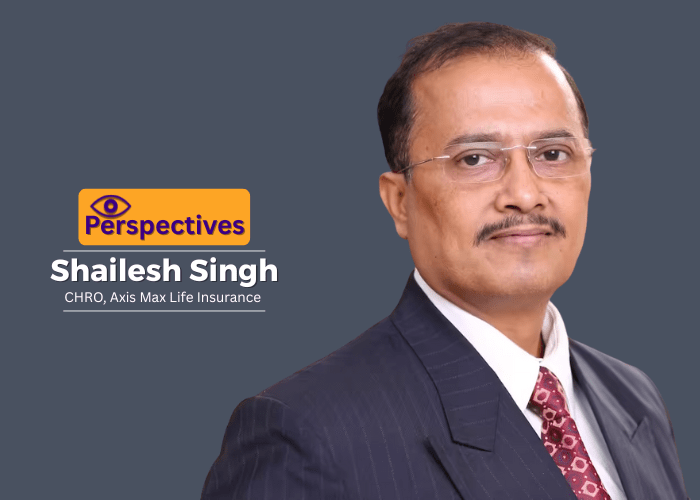
The modern workplace operates at the intersection of disruption and possibility. Technical skills depreciate faster than ever, five generations coexist with conflicting expectations, and artificial intelligence has moved from abstraction to everyday tool. For human resources leaders, the challenge is architecting organisations capable of continuous adaptation without losing their essential humanity.
Shailesh Singh, CHRO of Axis Max Life Insurance, confronts these tensions daily. He outlines how his organisation approaches talent acquisition in an era of accelerating obsolescence, the practical difficulties of serving multiple generational cohorts, and why the most sophisticated HR analytics still require human judgement.
The skills paradox
Technical skills now carry a half-life of under five years. Are you hiring for today’s skills or tomorrow’s learning capacity?
The answer depends on the role. Expertise-driven functions—actuarial science, legal, hardcore technology—demand technical depth. That premium persists. But across most other areas, the calculus shifts decisively towards adaptability.
We emphasise learnability: the capacity to absorb new information, update mental models, and remain intellectually curious. This matters at every organisational level, but particularly at senior ranks. Junior hires need technical competence to execute. Senior leaders need the metacognitive ability to navigate ambiguity, influence outcomes, and function as catalysts for change.
“Future-ready” talent means three things: technical mastery where it matters, soft skills as a universal requirement, and continuous learning as non-negotiable. Organisations that fail to embody these values risk calcification.
“Learnability is the new premium—technical skills are just table stakes”
The generational reckoning
Can a single organisational culture genuinely serve baby boomers and Gen Z simultaneously, or is fragmentation inevitable?
The transition is happening fast, particularly post-pandemic. Different cohorts hold fundamentally different expectations, and organisations must adapt rather than wish those differences away.
Older employees tend towards patience, long-term thinking, and deferred gratification. Younger workers live in the present, shaped by prosperity and expanded choice. They question authority reflexively, demand transparency, and prioritise work-life integration over traditional loyalty.
Legacy organisations face a steeper adjustment curve than startups, which begin with contemporary operating models. But adaptation is not optional. Younger cohorts will soon dominate the workforce. Their preferences—for flexibility, candour, collaborative structures over hierarchical ones—will define organisational norms.
The question is not whether to accommodate these shifts but how quickly companies recognise and respond to them.
“Too much recognition is never a problem”
Internal pipelines versus external talent
Do you prioritise developing leaders internally, or do external hires provide necessary fresh perspective?
Building internal bench strength remains the superior long-term strategy, but I believe in the power of “and” rather than “or.”
External hires carry hidden costs. Beyond compensation premiums, integration takes 18 to 24 months—and many leave before delivering meaningful impact. That inefficiency makes the investment questionable at scale.
At Axis Max Life, we conduct structured Organisation and Talent Reviews. Every supervisor presents their people strategy, which eventually reaches the CEO and board. This identifies successors for critical roles. We can fill 60 to 70 per cent of positions internally, making transitions smoother and preserving institutional knowledge.
External talent serves specific purposes: niche expertise, geographic requirements, urgent capability gaps, and fresh perspectives that prevent insularity. The optimal approach blends strong internal pipelines with selective external recruitment.
“AI should be in everything—but not everything in it”
How are you positioning artificial intelligence as a tool rather than a threat?
We haven’t yet realised AI’s full potential, but we’re moving deliberately. On the customer side, AI personalises products and accelerates query resolution. Internally, we began with senior leadership—intensive workshops where executives deployed AI in real projects. This hands-on approach demystifies the technology.
Given regulatory constraints in insurance, we proceed cautiously. Within those boundaries, we’re embedding AI into core processes: hiring funnels, talent development, training design. In recruitment, AI identifies candidate patterns and traits, sharpening our funnel and accelerating manager decisions.
We avoid overhyping AI as total replacement. Instead, we position it as a collaborator that amplifies human capability. Adoption is gradual—small cohorts first, then leadership teams, then broader deployment.
“Gen Z will dominate the workforce—legacy companies must adapt or perish”
The limits of HR analytics
People analytics promise better decisions. Are we delivering on that promise, or automating bias?
Data should be embedded across processes, not treated as a standalone silver bullet. The phrase we use is “in everything, not everything in it.”
The clearest impact has been in hiring. At our scale—sometimes 10,000 hires annually—AI transforms efficiency. It filters CVs, identifies traits, highlights patterns, and narrows pools far faster than human recruiters alone.
Performance analysis is another high-value area. AI helps us identify which profiles succeed in specific roles, feeding back into hiring criteria and continuously raising standards.
Analytics aren’t a panacea. Used intelligently, they deliver genuine impact. Used carelessly, they accelerate flawed decision-making. The distinction lies in human oversight and contextual judgement.
Recognition as cultural glue
How do you ensure recognition feels authentic rather than bureaucratic?
Recognition works when it’s instantaneous, genuine, and inclusive. We’ve built multiple layers and formats.
Our “I Appreciate You” platform—digital and physical—enables peers and managers to offer immediate thanks. Functions recognise a percentage of their teams quarterly, reviewed by senior leaders for consistency. Monthly town halls and webcasts provide broader forums.
Our annual day celebrates tenure milestones—10, 15, 20, soon 25 years—alongside CEO-led awards such as Business Stalwart or Woman of Substance. Recognition also links to values: employees demonstrating customer obsession or growth mindset receive public acknowledgement.
The guiding principle: recognition at multiple levels, in multiple forms, as frequently as possible. We tell people not to overthink it. The goal is to make it spontaneous, authentic, and woven into daily organisational life.